
Building the Littlest, Biggest Firm in America
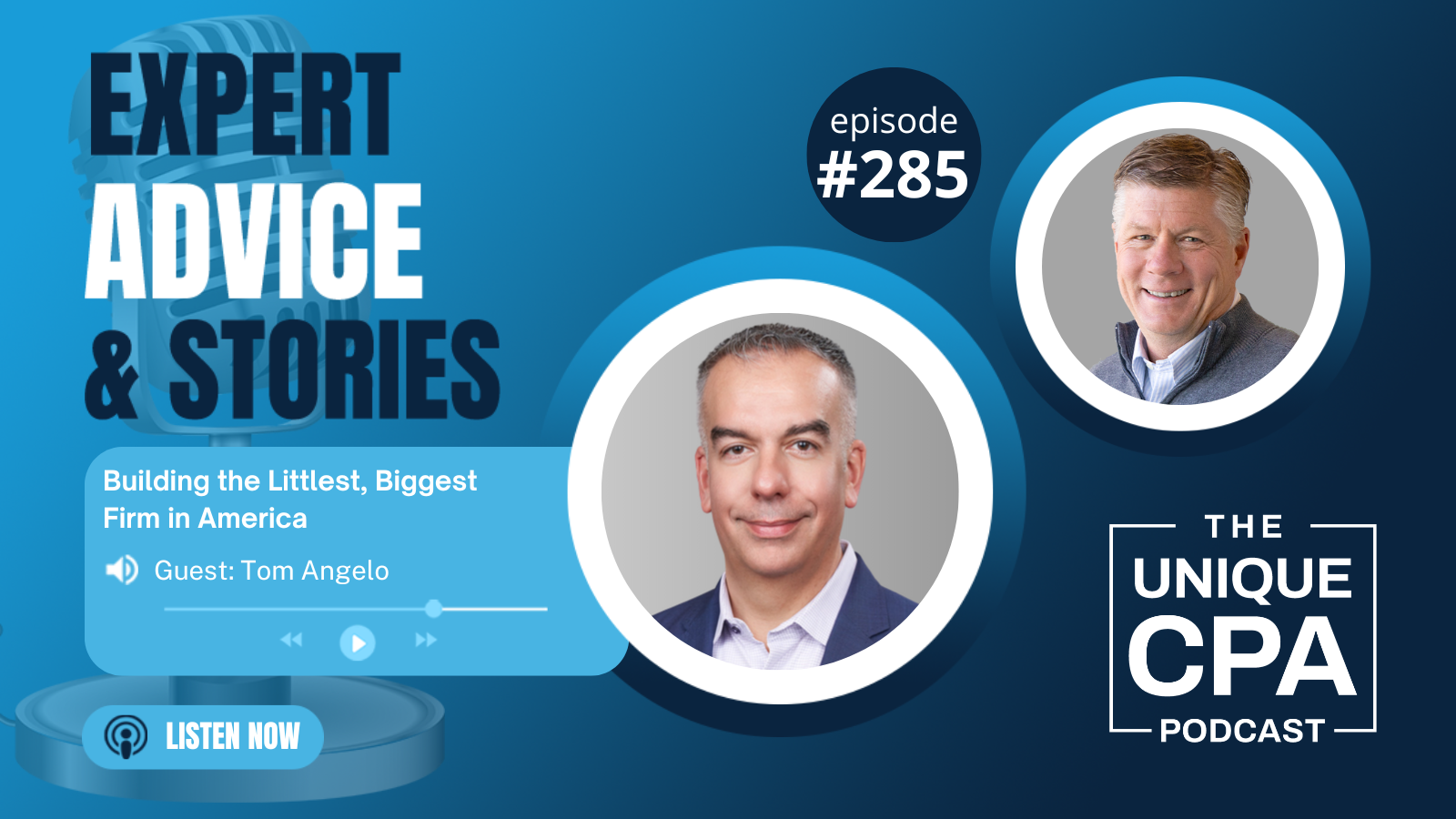
With Tom Angelo
Tom Angelo started his career above a pizzeria, hired as the first staff accountant at a three-partner firm in New Jersey. He made partner at 28, built an IT services arm years before “digital transformation” became a buzzword, and eventually merged his own firm into HBK. Now its second CEO in 75 years, he’s steering the company through Catalyst 2030, a strategy built around industry-led teams rather than geography. On Episode 285 of The Unique CPA, he and Randy Crabtree dig into how HBK weighs acquisitions, why cross-selling remains stubbornly difficult even with the right incentives, and what AI can and can’t replace when it comes to clients who have built their businesses over generations. Tom also stresses that with new hires going forward, the focus should be far less on data entry, and far more on curiosity and client-facing comfort.
Show Transcript Hide Transcript
Today’s guest is Tom Angelo. Tom started his career at a four person firm, built an entrepreneurial firm of his own launched technology services business before digital transformation became a buzzword and eventually merged that firm into HBK. Today as only the second CEO in HBK’s 75 year history, he’s leading one of the nation’s top 50 accounting firms through a new era of growth and transformation. Tom, welcome to The Unique CPA.
Thanks so much, Randy. Love your podcast and happy to be a guest today.
Yeah, what do people say? First time caller, longtime fan?
That’s right.
We’ll go with that.
I mean, I’m not so sure I’m in the groupie or the, what do you call the groupie club, but if there is one, maybe send me a link, I’ll join.
We need to get one. Alright, well, I appreciate you being a listener. I’m always amazed when people tell me they listen. So I appreciate you being that one listener we have out there.
I think my wife teases me. She’s like, you’re going to work out on the treadmill and listen to podcasts about accounting? She goes, don’t you want to get away from that?
Oh, I do the same. I’m listening to podcasts on the elliptical. Not the treadmill, though. My knees aren’t good enough for the treadmill, I need an elliptical. But yeah, it’s a great time to absorb information and man, I just love absorbing information these days.
And there’s no shortage of it. And there’s so much going on in the profession that you don’t have to listen to the things about tax anymore. There’s just so much other things going on in our profession that makes it so exciting, to be honest with you.
And I love that you said “exciting,” ’cause it is a super exciting time. Let’s talk about your exciting journey because it wasn’t, you know, maybe traditional into being managing partner, one of the largest firms in the country. So give us a little more background. I teased it, four person firm, technology, merging in, but give us a little background.
Sure, sure. I mean, I started probably in a different way than a lot of people. I mean, you know, a lot of people go to the Big Four right out of college. They get recruited out of college. I ended up going down the road of interviewing at smaller firms in New Jersey, which is where I’ve, I live and where I’ve grown up. And I think I always wanted to be an owner. So I probably loved owning a business and being the entrepreneurial component of a CPA firm more than I loved, let’s say tax, or audit, or those passions. I mean, I think I was good at it in the beginning and then my creative, sort of entrepreneurial spirit took over. But I ended up getting my first job, right out of college was with a CPA firm that was three partners and they had one administrative assistant and they were literally hiring their first, what they would call staff guy. I go to the interview and it’s located above a pizzeria restaurant, and that’s where I started my career and worked in that place until we moved to a, what I would call a big boy office.
So did that firm actually merge with HBK or was that the side business that merged with HBK?
No. So what ended up happening was, so we had the three partners that you know, and I was the first staff, and they ended up hiring another staff a year later. And what ended up happening is one of the partners got an offer to become the CFO at our largest client. And that kind of opened up a path for me to become a partner at a pretty young age. So, you know, I took the CPA exam a few times, wasn’t exactly one of those out of the gate standardized test takers that were super good. So it took me a little bit to get that, but I bought into my firm when I was 28, which was an early, I think back then, I think nowadays people do become, you know, we certainly make partners in our firm at 29, 30 years old, but that was early then.
And at that point, that was probably around 2000, we kept growing. The firm name changed a little bit as we continued to grow. We did a couple small acquisitions, we had a little bit of a lateral merger. But we ended up with a firm called Spire Group, and we had gotten that to about 35 people before we merged into HBK in 2018. A couple years backwards from that, in 2012, I had the idea, we had a lot of clients that were basically looking for IT, technology help. And back then a lot of the clients there weren’t as many, like what I would say, formal providers. Our clients guys had computer guys they called on their phones and said, “I have a problem, can you come help?” And I said, “We need to build a business around this.” So in 2012, we organically started an IT business serving the lower small business clients with what are called managed services, like subscription-based IT services, and we grew that business. So in addition to the 35 person CPA firm, we had eight or nine people in that business, by the time we merged into HBK.
Nice. Okay. Alright. So that gives me the full story. Well, not the full story. We could probably go hours on that or days on that. And that gives me an idea of the mindset you have now because you know, you’re not just tax and accounting, you have many different services including IT and wealth management and I assume HR, valuation, things like that. So let’s talk about this transition from this four person firm to 35 person firm plus the eight or nine additional, and then merger, HBK, and how long was it before you became only the second managing partner in HBK’s history?
Yeah. I mean, believe me, Randy, I feel very blessed where my career has landed. I had become the managing partner of our smaller firm, so for a few years prior to us merging and, you know, we had a great firm. I was really big on the culture of our team. We had just an incredible group of people. And it was so much fun too. It was just a fun group of people that, to be my partners, my team. But I felt like we were hitting this inflection point. We had grown this business and I’m like, “Are we going to be able to create enough opportunities for everyone in this firm going forward?” And I was the youngest of all our partners. So I started thinking about, well, they’re going to want to retire at some point. I mean, here I am in my lower 40s and I’m like, well, who’s going to do this with me? Am I going to be able to make sure I have the right talent? And I started to have strategy sessions with our partners and we decided, let’s look at merging up would look like.
We talked to so many firms and landed on HBK because we felt like the entrepreneurial culture existed there, that that would still, if I was going to give up, being the managing partner and then just becoming a partner in this firm, I still needed to feel like I had the ability and the support to be entrepreneurial there. And we ended up doing that and that’s what happened. And then, you know, I started off just running the local office, being the office leader. Then I ended up getting the position of running the Mid-Atlantic, which was at the time, you know, Philadelphia and New Jersey. We’ve since expanded into New York. And then our current CEO was going to be hitting retirement age and they launched an internal succession search for the replacement. And I put my name in that hat. And that was a good two-year process of interviewing and wow personality tests. And they went through a pretty rigorous process to get that. But I felt very blessed to be able to get that position in September of ’24, is when I officially started in that role.
Nice. Alright, so you mentioned the whole process of HBK and what you were looking for and the innovative and entrepreneurial type spirit. How did that manifest itself, you know, prior, that’s first. Was it just, hey, we’re just due tax and accounting differently than everybody else? The entrepreneurial side of things, or is it where we, I mentioned earlier HR and valuation and investment. Was that all part of HBK or has that expanded now since you’ve taken over as managing partner?
Well, I would say what did differentiate them at the time was obviously they had been one of the few firms that had been super successful building a wealth management practice. I mean, they started the wealth management practice probably in 2010. Maybe it was somewhere around there. Actually, no, it was maybe like 2002 or 2003, really early on. Bought an RIA, a small RIA in Erie, Pennsylvania that had about $180 million in assets. They were very successful at building the cross-selling engine. Our client base is really lower middle market entrepreneurial families. We don’t do any public companies, so there was a perfect combination of wealth, so they had scaled that massively to the point where today, we’re just under $9 billion under management and we’ve got 130 people dedicated to the wealth business. So that was a differentiator. They had a valuation group, but they didn’t have the IT services, which, you know, allowed me to bring that in and continue to grow that. And that’s where I kind of felt the entrepreneurial, like, hey, I could still help them build something here. Like I’m not just going to be another partner on the factory floor. Like they’re going to let me do what I want to do. And that was a big factor of why we chose HBK.
Nice. Well, let’s talk about that then. That entrepreneurial spirit and that growth mindset. ’Cause at the beginning in the intro I talked, you’re leading through a period of growth, and I know you’ve done that through acquisitions and obviously organic. But when you’re looking at growth, is there a certain, let’s say, hey, we’re going to go, we’re looking at acquisitions. Is there a certain way you determine what would be a good fit? Is it a service line? Is it geographic? Is it talent? Is it all the above? When you’re out looking at opportunities, what is the lens you go through?
Sure. Well, you know, it all starts with, you know, we built a new strategic plan when I became CEO. We call that plan Catalyst 2030, which is like our catalyst to growth. And it’s a combination of many things, but we pivoted our model from a geographic office model to, we lead by industry. We have 20 offices, but everybody in that office is part of a bigger industry team, and that’s how the firm goes to market. So if we’re going after, you know, consumer goods companies, like our consumer goods team is doing it, if we’re going after real estate, our real estate team’s doing it. And that team could be spread out in two or three offices depending on what happens.
So when we are looking at our growth strategy of looking for really quality firms that we want to join. The first litmus test is always people, you know, I think you spend some time getting to know the partners. You really have to look back and say, hey, would I go to a Yankee game with these guys? You know, these partners? Would I go out to dinner with them? Do I want to have a beer with this person? If you feel like you can’t do that, everything else isn’t going to matter when it comes to doing these types of deals. But once we do that and we look behind that, we say, do they bring something to the table that we don’t already have, and that’s a plus? Or do they bring something that helps us scale something we have even bigger and gives us even more market presence? And sometimes we find both of those aspects in the M&A target and sometimes, you know, it’s just one of them. But we need something that aligns with our strategy, right? Like we’re not going to go acquire something that doesn’t make any sense for us. And then do we believe that if they join us, that we’ll all grow together? Because if we don’t, then we’re going to do a lot of work for no reason. And it’s never just about adding to the top line, it’s like, is this going to get us both further to where we want to get to. And that’s the way we look at it.
So it sounds like you’re very niche built, right? I mean, hey, we have whatever it is, real estate and all these different. What would you call those? When I hear “silo,” it sounds weird to me.
We call them industry solution groups. So, you know, so within a solution group and we say solution group ’cause we’re trying to deliver these solutions to those specific industries. But we probably have about 10 practice lines that are consolidated into only six industry groups. And we try to stay very close to that if possible.
Okay. So each of these 10 industry lines in these six groups, some of them will have unique needs. I’m assuming generally, hey, everybody’s tax and accounting and everybody can use HR and other help. But is there ever a service within that service line that you’re like, hey, this is something that we keep getting asked for and we’re not currently doing, is this a target we should go see if there’s an acquisition, or can we build this internally to add this additional service for this, or this, make sure there’s a line?
Yeah. One of those things happened last year. I mean, we obviously make many firms. Client accounting services is a big, fast growing component of clients wanting to just say, hey, take the day-to-day accounting off my plate, you guys manage it. In doing that and growing that, they started asking for HR help too. And that was something we did not have. So we did a very small acquisition in 2025 that essentially got us an HR practice leader and, you know, four or five team members that’s just focused on providing outsourced HR assistance and recruiting to our clients. That was an add-on service we never offered before.
Nice. Okay. I like that. Alright, so I’m going to pivot a little bit, but I want to stay in that, sorry, what did you call it again? The offering in the industry segment. The, what was it?
Industry solution group.
Industry solution group. Okay, within this industry solution group, what I’ve seen in the past is like, hey, we get very tunnel vision. People can get tunnel vision on, hey, I do tax and so all I’m thinking about is tax, or I do CAS, so I’m thinking about CAS, or I do wealth. How do you get, when you’re working with a client, how do you get at this whole more holistic approach that, hey, you know, we have all these offerings that now can service you. How does this tax person understand that, hey, you know, we, like, I should talk to the CAS group or to the investment side of things because we have other services that this client could benefit from, and we’re really good at it, so let’s make sure we do it. So from across, I guess the, my really short question to this long one I’m doing is, how do you identify cross-selling opportunities and make sure this is a mindset people have with going into these engagements?
Yeah. I mean, listen, I think any firm you talk to would say that while it appears on paper that cross-sell should be the easiest path to growth, it is often the hardest because getting folks to open up the clients, you know? And part of that has to be constantly preaching that these are firm clients, and that the whole book of business model is in there. So we kind of relabeled the old school book of business and said, this is the revenue you are entrusted to manage on behalf of the firm as opposed to book of business. Because we’re saying these are now firm clients and your job is to make sure that they are getting all of the solutions they need, whether that be from us or someone else. We use a lot of ways to do that in terms of making sure that our advisory leaders are constantly visiting offices and doing roadshows and saying, hey, these are the offerings we can do, whether that be our state and local tax, our valuation, our technology group. And then we incentivize the partner group and the employees and the overall team to be able to bring those services to those clients. So they all have goals related to that. And, you know, while that sounds great, it’s still a very, very hard thing to do because the average CPA, listen, they’re very hardworking folks and they get very involved in their day-to-day, and they’ll probably say, “You know what? I should really introduce this person to our wealth manager. I see they have millions, you know, in all these different broker accounts. I’ll do it after busy season.” And guess what? After busy season, they forget or that doesn’t happen. So constantly trying to be in front of them is part of the process and making sure that they have goals and that there are incentives in the business aligned to help them. And that’s kind of the way we do it.
No, I like that. And that kind of leads me to another topic, so I’m going to again, pivot. We talked about almost like, hey, we’re going to remind them after tax season and we don’t, and that’s almost like a change in mindset: Let’s do this now, let’s make sure we’re on top of it. So change in general, obviously is a big thing in our profession. It always has been. I mean, there’s always change for, I mean, you go back to, you know, when QuickBooks came out, I mean, everybody was like, okay, now everybody’s going to do their own account or self filing tax. I mean, so change is always there. It’s just different now. It’s accelerated. You hear about, and I think I’m obliged to say AI in every episode now, just because it’s such a big deal.
Absolutely!
But you know, you as a firm leader or as a firm in general, in a large firm, there has to be discussions out there and on, you know, what is going on in AI? What do we need to integrate? How do you determine, you know, which not every shiny object out there isn’t going to be right for you. I think the fact that you’ve defined yourself with these industry segments helps you choose what is and what isn’t. But people in general can get overwhelmed with what’s going on. How do you manage that change or that mindset with them that, hey, this is how we’re going to look at things going forward, and this is what is important to us?
Absolutely. I mean, my mindset is, look, I’m just, as I’m sure every firm leader, whether you’re leading a small firm, you’re leading a larger firm, we’re all distracted by the shiny toys that are constantly, and listen, I think there’s some awesome startups out there right now in this space that, say they have great products, some of them do. The problem is not getting trigger happy and saying, let’s get this, let’s get that, and then trying to scale that. So what we’ve tried to do is say that to the people, well, let’s rethink the entire thing and say, if you had to deliver the best client experience and the best internal team experience, where’s all the friction, and how do we then say, can you put some automation around that process to reduce that friction and make it better for the client and make it more efficient internally? And if so, let’s hit that first, as opposed to just saying, oh, this looks like a good thing to get, let’s do it. I find those initiatives usually fail miserably.
Yeah, and it’s very tempting to go, wow, look at that! I need that. I’ve got to try that. But it’s also the same: Look at that. Oh man, I don’t have time for that. So there’s this balance there of, you know, what is going to, you know, you’ve defined what your firm is, and we’ve talked about that a little bit. I think once you define what your firm is and who you serve and how you serve them, and the services you offer, and all that we’ve touched on today, I think once you do that, it’s easier to determine what is going to support who we are and what we do. So I like the fact that when we had this discussion so far, you can answer all those questions of who we are and who we serve and what we offer because that, I think makes it easier. In fact, by the time this episode airs, Bridging the Gap will be over. But that’s a little bit of my keynote I’m going to give is on things like that. So.
That makes sense. That makes, I think you have to do that, and one of the things that you always have to stay rooted in, I mean, I always tease our team members when we’re doing town halls, you know, I said, yes, we’re a top 50 firm and you know, our run rate revenue is going to be north of 200 million. And I say, “We are the littlest, biggest firm in America.” I mean that in the fact that our clients are smaller and we’re okay with that. Like, we still deal with the $20 million manufacturing client in the Midwest where they’re on their second or third generation, and that family is extremely close to the partners and the team members. And I don’t think AI is going to replace that relationship. AI is going to some of that, but I still think when it comes down to wanting to have a conversation. How do I leave this to my son, but I don’t want to leave my daughter out. Like, AI’s not going to fix that. You know, that’s still a huge solution that a human and a talented human, and a compassionate human needs to still be involved in.
Yeah. Oh, no, for sure. So that comes to the next question then, and I thought I was wrapping up, but no, now you made me, I got another question, which is good. I mean, it is about developing leaders, but not even just developing leaders. It is about what are the skills going forward? ’Cause you just talked about it, but I think we have new skills that are going to be more important coming into the accounting profession than ever. And to me—now I’m skewing my question to you—but to me that’s exciting. I think we are going to attract people that wouldn’t have been attracted to the profession before. So do you see a different skillset needs to be honed more or brought into the profession?
I do. We’ve been telling our leaders now, there was a model, right? There’s the pyramid that we all, everybody in accounting grew up in and they said, oh, we’re going to hire a lot of associates out of school. Some of them are going to stay, some of them are going to be great, some of them are going to be sort of mediocre. I see that narrowing and, you know, we have a different model. We’re kind of looking at here, but I basically told them, I said, “You’ve got to hire the best talented people you can, but not only from what you would traditionally believe from the technical ability, you know, or a learning ability, but the people who have like the best social skills that you can put in front of clients much sooner in their careers.” I mean, I grew up in an environment where the first year you worked, you know, the partner went out and got all the work for you and kind of left you to do it, and then the partner was the front person. And now you really need that new associate to be very comfortable with a client quickly, because some of the things that they used to do are being done, whether we’re using our offshore team, but also with technology. You know, to say you’re going to spend the next three years plugging numbers into a tax program or you know, signing off on cash work papers in an audit, those things are changing and we’ve got to get them to be much more analytical, much more client-focused on saying, how do I identify problems? Things like that.
Yep. And then that leads into the, you know, if we wanted to call it that, the cross-selling too. Because when they have that personality, when they’re asking questions, when they’re curious and seeing opportunities for bettering this client, that brings in other opportunities for the firm as well. So I agree. I think that’s a huge skill that we’re going to need. We’re not just sitting at the computer data entering, putting data in. That’s not a thing. Or it won’t be, if it still is, it won’t be as much anymore.
Yeah. I agree. I agree. I mean, they have to still learn the business, because they have to know when is something right and when is something wrong. But at the same time, do we still need them to input, you know, W-2s and K-1s and, you know, I don’t think so.
No, I agree. And I don’t think people want to, I mean, that’s not a sexy part of the job.
No, it’s not usually what they want to, you know, they come in and say, you know, “I just went to four years of college and, and you, you’re having me typing in information.”
Yeah. No, for sure. Alright, so let me ask you one question before we go to the final two questions. But the last question then is, so we’re just talking about the needs going forward of, you know, people coming in and the skillset. If you and I were talking, let’s say 10 years from now, and that’s the first time I think I’m asking this question, what will the most successful accounting firms be doing differently, or what will they look like different than they’re doing today?
Yeah, I mean, I think the world of compliance is going to take a backseat. I think we’re always going to do it, but I believe that we are going to be the firms that when our clients want to have a catalyst for change in their business, that we’re going to be that source. And whether that’s going to be technology, whether it’s going to be HR, talent, digital transformation, marketing, I really believe that we’re going to become a powerhouse of providing those solutions. And yeah, we’re still probably going to do the tax returns in the audits. But that’s going to take a little bit of a backseat to the real advisory work that will be a catalyst for change for our clients. And that’s what we’re shooting for here at HBK.
I’m going to start using “catalyst for change.” I’ll give you credit though.
Okay, I appreciate that.
Alright, so as we wrap up then, two final questions that if you sound like you listen to up, this shows before, so you probably know this, but when you’re not building the HBK, when you’re not leading everybody through, you know, this moment of change and figuring out what’s next within the firm, what do you do for fun? What’s your outside of work passions?
Yeah. Well, you know, in those spare few minutes, that my phone or email’s not going off, but no, for sure. I mean, listen, I’m a huge fan of, you know, I live about 30 minutes from the New Jersey shore, so I am a beach, boating, anything on the water kind of guy. I live for the spring, summer, you know, early fall for that. So anything to do with the water is right up my alley. We like to travel. So, you know, despite this crazy career that I signed up for, we do get to take a bunch of trips a year and whether they be long weekends to cool places or big trips to Europe or whatever, we love to travel. And then, my wife and I are just massive foodies. So not only for cooking at home, we do a lot of that. I make a lot of homemade pizza, but we also are big people for trying new restaurants, making sure we go to the ones that we like. So we live for that.
Nice. Yep. Well, that’s awesome. And then last, if people want to hear more about HBK or you personally, where’s places they can look?
Yeah, listen, I’m pretty active on LinkedIn. You could always look me up. Tom Angelo on LinkedIn. I think my LinkedIn handle is TommyCPA. Or you could always reach me at TAngelo@HBKCPA.com. Happy to chat with anybody in the industry.
Well, Tom, I appreciate you being here. We, I didn’t say this at the beginning, but we just met two months ago out of the conference at Vegas and hit it off.
We did.
I’m so glad that you were able to come on the show.
And I really appreciate it Randy. It’s always good talking about the industry and a different perspective, so very much appreciate you having me.
About the Guest
Tom Angelo serves as Chief Executive Officer and Managing Principal of HBK and is a member of its Executive Committee. He was selected as the firm’s second Chief Executive Officer in 2024. Tom provides strategic direction for HBK, which includes focusing on maintaining and expanding the quality and depth of services and delivering increased value to its clients. He works with the various service lines and industry groups across HBK’s geographic footprint to ensure that investments in our people and resources continue to help guide its clients to achieve their goals.
With over 25 years of experience in public accounting, Tom has served in various leadership positions both in his prior firm as well as HBK, most recently as Principal-in-Charge of the Mid-Atlantic Region. Tom was instrumental in growing the firm’s technology services practice, Vertilocity, as well as expanding the firm to the New York market. Prior to his leadership positions, Tom provided tax and consulting services to high-net-worth individuals and entrepreneurial family-owned companies. Tom remains passionate about digital transformation and technology both for the firm and its clients.
Meet the Hosts
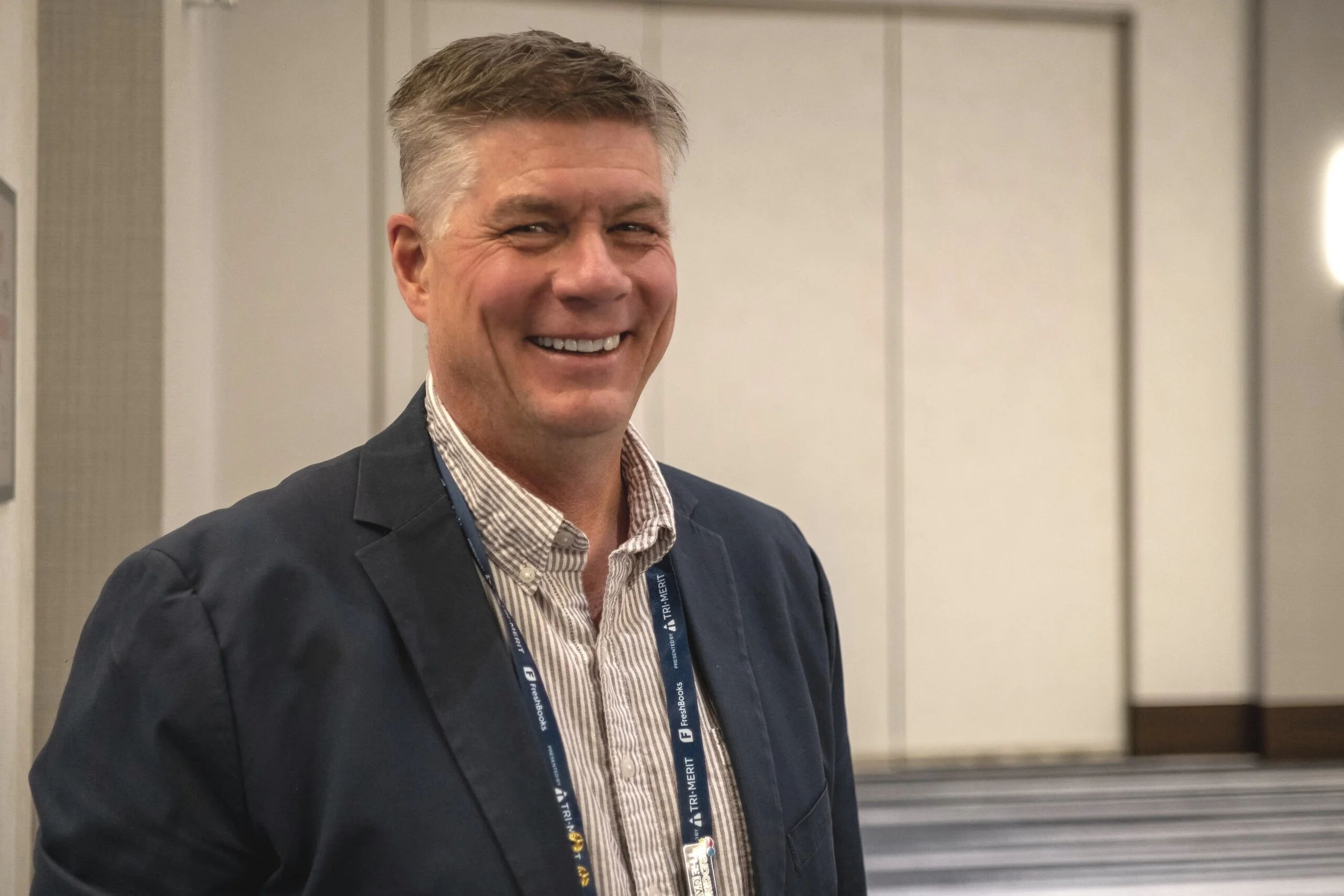
Randy Crabtree, co-founder and partner of Tri-Merit Specialty Tax Professionals, is a widely followed author, lecturer and podcast host for the accounting profession. Since 2019, he has hosted the The Unique CPA podcast, which ranks among the world’s 5% most popular programs (Source: Listen Notes). You can find articles from Randy in Accounting Today’s “Voices” column and the AICPA Tax Advisor, and he is a regular presenter at conferences and virtual training events hosted by CPAmerica, Prime Global, Leading Edge Alliance (LEA), Allinial Global and several state CPA societies. Randy also provides continuing professional education to Top 100 CPA firms across the country.

Terrell Turner is a 3x nationally ranked CPA, 2x Top 20 Global Finance Influencer. He is the founder of the TLTurner Group, which has been recognized in NYC Times Square and the NY Times as a top accounting and CFO firm that specializes in supporting law firms. Outside of running an accounting firm, Terrell hosts multiple vlogs and podcasts in addition to co-hosting The Unique CPA. Terrell is also a speaker and a content creator who regularly hosts and collaborates on video and audio content projects with multi-billion dollar corporations, bar associations, universities, and non-profit organizations.