
What Actually Makes a Firm Valuable?
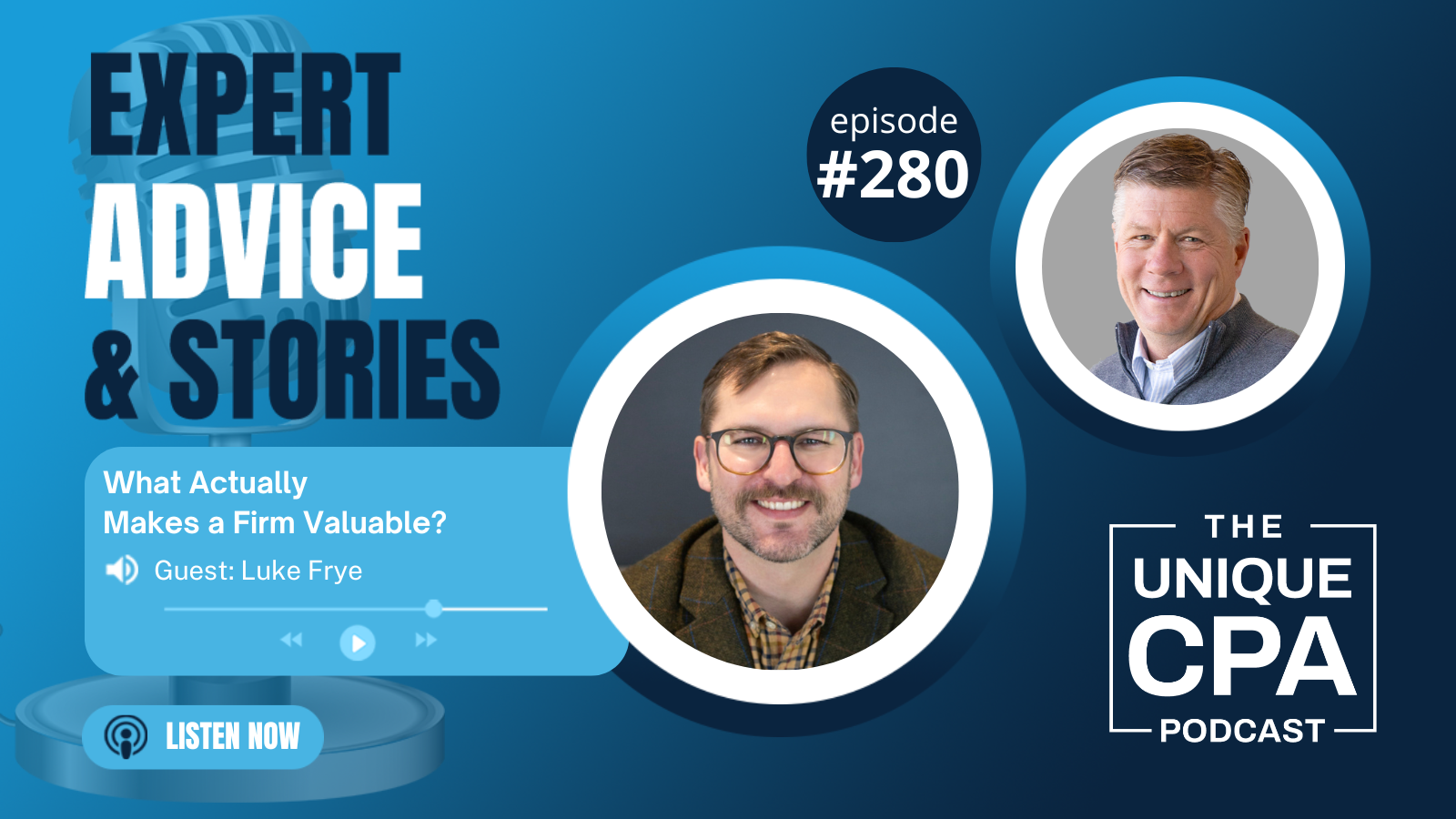
Answers with Luke Frye
Randy Crabtree sits down with Luke Frye, who’s gone from hand-stamping journal entries as a small-town government accountant to scaling Bench to thousands of customers, running his own firm through a messy business divorce, and now advising practices at Canopy. Their conversation on Episode 280 of The Unique CPA keeps circling back to a single, uncomfortable question: What actually makes a firm valuable, as opposed to just busy? Luke argues that key man risk, not revenue, is the real threat to most practices, and that hourly billing quietly rewards inefficiency while punishing the AI tools meant to help. He pushes clients to charge what they’re worth instead of discounting out of fear, and to build systems, like a real CRM, that let a firm run without its owner chained to it. Randy’s own transition out of the company he built nineteen years ago and into advisory adds real-world weight to the discussion. It’s a candid look at pricing, succession, and the mindset shifts firm owners tend to avoid until it’s too late.
Show Transcript Hide Transcript
Today’s guest is Luke Frye. Luke is accountant in residence at Canopy, a company I know well. Luke has worn just about every hat in the modern accounting profession. From building his own accounting firm to working with companies like Bench Pilot and Puzzle, and now helping firms improve their operations and profitability. Today, rather than talking about the latest AI tool, which you’re probably all happy about, that we won’t be, or piece of technology, I want to explore something every firm owner should care about: How do you build a firm that’s actually valuable, not just busy? Luke, welcome to The Unique CPA.
Thank you, Randy. It’s great to be here. Thanks for having me.
Oh yeah, no, this will be a fun conversation today. But before we even get into that, I gave you a quick bio. Anything I missed or anything you want to add to that of, of your history in the profession or what you’re doing currently?
Sure. I mean, it has been really interesting looking back, you know, in the moment a lot of these things felt like failures in some way because you are taught you’re supposed to become partner at a public accounting firm and be there for your whole life and then retire. That just never really fit for me. And even before I got into tech and by luck and chance at Bench, I was a government staff accountant, like the staff accountant at a small town in Wyoming, where I was using pieces of paper to hand write a journal entry and rubber stamp the date. And that wasn’t, that wasn’t more than two decades ago. So it’s just kind of, when I look back, it is quite a wild ride.
Yeah. I can look back and say the same thing. It’s been a wild ride for me too, but it’s been a lot of fun, and I’m guessing that you’ve had fun along the way as well. Alright, let’s get into what I teased there, that, you know, let’s explore something a little different, you know, what makes a firm valuable? So everyone talks about growth. I mean, we hear growth and not every, I mean, growth to me is different to everybody, and I think it should be different to everybody, but I think one of the main things that should be very similar is value. And so I just want to ask something different rather than how do we grow? What makes an accounting firm valuable? And you’ve built a firm, and I assume you sold that firm, right? And so you’ve got history in this, so, so what is the difference, I guess, between growth and value inside a firm?
I think, you know, I’m going to do my best not to speak in clichés, but it depends mostly on. What you value. So if you value money, having really high gross margin and, and high EBITDA is going to be the most valuable thing. But if you value your free time, I think Erica Goode may have been on your podcast. You know, she’s a great example of one of these firms who she values free time. So it depends on whether you have a family, a hobby, a health situation on what makes it valuable. But if you’re talking more directly, which I think you were in initially, is revenue, money, sellability, that sort of thing. I think the biggest factor is what I’m now coming around to realizing is key man risk. You know, listening to some Alex Zi, the a hundred million dollars offers, which is very similar to the Gerber and Darren Root, becoming the CEO working on the business instead of in the business. So if you’re building something, you have a succession plan in place because the unfortunate factor is every business ends, whether you have a business partner. And actually my business that I started, we unfortunately had a business divorce. So I don’t have a glorious story of, hey, I built this business into half a million dollars of revenue recurring, and then I sold it for, you know, 3x multiple. It was much messier than that, but I still learned a lot.
Alright, so some of the things you said there: Define what value means to you, and I love that, and that’s something I’ve been saying more and more lately as well because especially with what’s going on in the profession now, and I probably say this too often, but what’s going on in the profession today is minuscule compared to tomorrow and the next day and the next day. Because we are changing exponentially, and you could have said that 20 years ago too. And it just continues that way. So when people talk about the change in managing change and what’s going on and creating value or whatever, I think one of the first things you have to do is define who you are or who you want to be as a person and as a firm. Because if you don’t have that in place, you don’t know the value you want to get to. And like you said, Erica Goode, the value for her is, I think she says 15 hour work week? I can’t remember. I think that’s what it is. And so when you look at through that lens, I don’t know if you agree with that, but defining who you are first, I think is one of the most important things to figure out what’s valuable to you.
I’m a huge Jim Collins fan. I read Good to Great more than a decade ago, and it’s probably still number one, if I have a Bible of business books that is Genesis for me. And I just think so much about your long-term vision or your mission and, and then that helps you get clarity on your values too. But if you have that North Star in mind from the beginning, it’s easy to decide what clients are saying yes or no to, because that may be in a niche or not, or it may be that personality or not, or it may be a revenue level or maybe a regional. Whatever it is, if you have a long-term vision, I came up with a saying in some of my coaching calls where I say. At the beginning, what do you want to be when you die?
What do you want to be when you die? Am I supposed to answer that?
You can, sure.
Honestly, I think I want to be remembered for having a positive impact on people’s lives.
So the next question would be, “and how would you do that?”
Yeah, well, so in my current role, it is impacting, well, family’s always number one, but in my current role, it’s, it’s actually helping people, I think kind of, this is what we just said, define who they are in this profession. I want to encourage people to not fear change, because if we fear change, we’re going to be in big trouble. And then I wanted them to dial into the change that’s important to them, that’s valued to them, and that change has to have a positive impact on them and the people they work with, but then will translate to the firm and the clients.
Yeah, I said I wouldn’t use cliches, but the reality is, you know, the only constant is change and we have to continue being adaptable, otherwise you die.
Yep. So what answers do you get when you ask people that question?
You know, anything ranging from, “I want to be the dad in succession,” down to, you know, very similar things to what you mentioned around family. You know, I also have a handful of people who, well, I have one person I work with who she very much just wants to build a business that really sustains her and her family. She doesn’t want to build a multimillion dollar practice. I have another client, they see it as a huge, I’d say, as unnecessary and maybe even evil, you know? And so it’s really interesting to see, but a lot of it comes down to like what you were saying is, I want to do good, I want to support my family, I want to make sure that I, I make an impact and embrace change and, and innovative, but human, which is, I get the fortune because I’m at Canopy and so any of my consulting stuff is just on the side, I get the great fortune of getting to be very choosy about who I work with. And these are very human people who it’s just a joy to be around and work with.
Yeah, that’s awesome. My future is changing. I’m now retired from Troy Merritt, the company I started 19 years ago, as of the end of last month.
Congratulations. That’s amazing.
Thank you. But the thing that I get to do going forward is I get to team up with companies that, like you just said, I have three criteria: One, I have to like the people, the team, two, I have to like their product, their service, and three, I have to believe their product, their service have going to have a positive impact on the lives of people in the county profession and help that firm, those people in those firms thrive. And so, yeah, I can be picky and choosy and figure out who that is, and I think every firm should have something like that. We don’t have to help everybody. I think we have that mindset way too often that, hey, we’re accountants, we have all the answers. We’ve got to help. If we don’t, who’s going to help? Not to go down this rabbit hole right now, but the problem is, that doesn’t serve you as the firm owner or your team the best. And that’s what I always look at.
I think just like in any sort of relationship, you can’t abandon yourself in order to help someone else. You need to stay in integrity with your values and who you are and operate in your zone of excellence or at least competence. And yeah, especially early firms starting out stretch themselves way too far, taking work. They shouldn’t, in part ’cause they need money and in part because they feel like they don’t know how to say no, and it makes them feel good to say yes and be needed. But the sooner you have some baseline of income and the ability to say no, the better.
Yeah. I’m very proud of my son, who, I’ve mentioned this I think on the podcast, maybe not this way, but he started his own CAS practice in January, so we’re sitting six months ago. He said to me recently he’s putting a pause right now on taking in new clients, because he wants to make sure that he sets the base of how he’s going to work with clients, make sure that he’s got all the processes and procedures and automations in place so he can scale the firm that he wants to actually grow. And I’m like, man, I never had that thought process when I was his age, going out to do that. So I’ve learned this over the years, but not nearly as early as he did, so I’m pretty proud of that fact.
It is really interesting, right? Because everyone comes from different socioeconomic backgrounds. You know, I helped scale Bench from zero to 3,000 customers. How did I do that? Well, I mean, I was an office manager, there was an executive team. I was the first accountant, but that also the second accountant, who’s one of my best friends, she was right by my side and there was millions of dollars in backing. Right. And then when I went off and did my own practice, that was what in tech land we call bootstrapped, right? Or what I call “a real company that has to pay taxes.” And I mean, I shouldn’t be too mean to tech because they’ve given me a lot of benefits in my career. But I mean, the reality is I had to pay taxes, I had to make money, like net money after expenses to pay my rent. It wasn’t like I could just spend a hundred thousand dollars a month on Facebook ads to get leads.
I mean, we could do a whole podcast on just that discussion we had. I, I love that conversation so far. But one of the things that I do want to get into, ’cause you do have a goal when I read your bio, you have a goal right now of, of helping firms add $10 million in collective revenue this year, and so give us just a little background on what this goal is and, and why you have it.
Absolutely. So back to Jim Collins. He has these things called BHAGs, which firstly, I don’t love the sound of the term, but it’s very memorable, right? “Big hairy, audacious goal.” So it’s something to really stretch yourself. I’ve been around several different types of practices, and I’ve seen lots of things that work and things that don’t work in certain situations. And what really is the bottom line for all of the people I encounter is they want to grow somehow. And the way I’ve spent most of my career really is sales. I’m a sales person pretending I’m a CPA in a lot of ways. But in reality, I think every CPA is a salesperson, they just don’t want to accept those words, because they feel very charged.
So the $10 million goal really came from this idea of like, what’s so huge that I might not be able to get it? And I will also say I came up with that goal before I started at Canopy, but also one of the reasons I decided to join Canopy is they have expanded my impact, you know, through conversations through their product. I have a client that I was working with who didn’t have a practice management platform or a CRM at all, and there were lots of problems associated with just running things off of a spreadsheet. They’re now on Canopy. And I think that that’s going to help them grow and scale so much faster. But you know, to really take it back to the ground level of why I chose those numbers is when I do some of my consulting. I like to align my incentives with their clients, and usually that’s around sales and revenue. And so what I typically do is charge a monthly fee plus 10% or 20% of the annual revenue that is attributed to my advice. So that’s first year revenue going back to me, and the retainer goes towards that. So if you back into that, that means I would net like a hundred grand, or wait, a million, I would net a million.
Yes. I was doing the math!
Yeah, thank you. So that’s a pretty big, hairy, audacious goal. I will say I’m very far behind on that right now, so I’m going to have to really refocus through the rest of the year. Either way, it gives me a lot of clarity on how I want to make decisions this year. And if I don’t hit that number this year and I keep working on it for 10 years, and in 10 years I hit that goal, I think everyone I’m working with will be very happy, and I will also be very happy.
You got it. And then there’s positive things people are doing to hit those goals. Obviously the clients you’re working with have a growth mindset and that’s why this comes in. And so as we talked about earlier in the conversation, everybody’s different. Everybody has a different goal and who they are and what they want to be. But what are some of the positive things that you see the firms you’re working with do to meet their personal growth goal?
I think the biggest thing that has been fun to see is people embracing things that are outside of their comfort zone, usually around sales. But there’s also, I think, quite a lot to do with your self-worth and your own, like, right to exist. And part of this is imposter syndrome, right? And, and so we’re on a call with a client and. We’re discounting from $5,000 down to $3,000 before they even said anything. One client who sent me a proposal on something and they said, I was going to charge 20 for this, 20 grand for this thing. Do you think I could charge 25? And I said, you should charge 30. And this was, their customer was like a very large company, so that’s like a rounding error at most. And I had had dinner with this person, and I could just tell didn’t really believe they were worth what I know they are. A week or two later, got a text message, they signed for 30.
There you go.
And it is purely just understanding your value in the market. And that’s why, you know, I’m such a big Ron Baker fan. I have this book. I haven’t gotten through it all the way yet, but I just don’t believe in billing by the hour. It just feels wrong. And if you saw the IRS regulations recently, or guidance, I guess, that were updated on AI, the IRS is telling you cannot charge more or the same. If you use AI and it took less hours because they assume everyone is billing by the hour. Because that would, that would technically be fraud or lying. If something that took me 10 hours and it took me one, but I’m still charging the 10 hour rate, that’s just a mess.
Yeah, that’s crazy. No, I’m a big fan of Ron’s, as well. In fact, when my son started his business, Ron got on a call with him and gave him some advice. So I appreciate him doing that.
That’s amazing.
Good guy.
He is.
Yeah. So what I’m hearing there is the things holding people back is often mindset, imposter syndrome, and I completely agree with that. The one thing that I teased in the intro was that busy isn’t valuable. And so we talk about the fact that we’re busy all the time. And if somebody asks you, how’s it going? Oh, I’m so busy, so much work, so many deadlines. But that is when we go back to the original conversation of value in my mind, I guess you can value busy if you’re going to work 80 hours a week, but we don’t want that. We want to not be billing by the hour. So how do you get people out of that mindset of busy-ness is creating value for me?
Yeah, I have a few thoughts on this, especially having friendships in adulthood and trying to schedule things. Everyone’s so busy, right? To use another cliché that I promised not to use is, you always have time for things you value. So if you value your family, so we always have to make trade offs at a certain time, but if you value your family, you’re going to prioritize getting to dinner, going on vacation, not being on your laptop, those sorts of things. But unfortunately, my hypothesis on busy-ness is it’s attached to low self-esteem, low self-worth, and an addiction to feeling good and needed through work. So it’s workaholic, essentially. We’re told, you know, you study hard, you stay up all night, you do the 80 hours a week in public practice, we’re trained into this. So we don’t have to take full, like it’s not our fault, but it is our responsibility to fix it for ourselves.
Oh, I agree completely. And especially going back to, you know, what you said with, well, we’re going to skip the IRS right now, but with AI creating efficiencies, we should be able to take advantage of those, because it’s still our knowledge that is doing this. And if we just go to, hey, I’m billing less because AI is part of it and my value’s only based on the hours I put in, that’s just going to continue that “busy-ness is my value.” I’m a big proponent of doing everything we can to avoid burnout. That is just going to perpetuate burnout. So we need to get rid of that mindset. Oh, we keep coming back to mindset, one of my favorite things. So we need to get rid of that mindset.
Let’s continue down that value path a little bit. And so, you know, you’ve been part of a transaction with a firm, you are advising firm owners right now. And let’s assume that you come in and you’re going to buy my accounting firm tomorrow, and you get in there Monday morning and you take a look at it, and what would you look at that would say, hell, you. This is not the firm that I expected. You just created a job for me rather than an asset that creates value. I mean, what are those things? People are doing that just as a job rather than creating an asset with their business, which I think most people don’t look at. They should, especially with everything going on these days with M&A and PE and everything, but I think often accountants forget that their firm is an asset.
Absolutely. I think the number one thing really is having a good database, which we call a CRM. And that roughly translates to a practice management platform, which takes over some of those jobs to be done, and some of it is not. Like we still need Hubsoft or Salesforce or one of the other new entrants for lead gen and working a pipeline, and those ideals. But as a component of that, you create a 360 degree view of your firm because there’s transparency, there’s visibility. I’ve heard multiple stories from firms who, a shareholder ended up siphoning off a bunch of clients, and they’re a remote firm, they’re a very trusting firm, and they got cheated. And in part because there were no internal controls around communication. I think we think of internal controls around money, I don’t know if we think much about internal controls around communication.
And so on one hand I would probably be really excited about buying a firm that didn’t have a CRM or practice management or automated billing or call recording, which those are my three core pillars of what I recommend all firms have. On one hand, I’d be excited because then I get to implement it, right? That’s still a big change management project. But if I were in as your advisor and you didn’t have any of that stuff set up, I would be like, instantly, you know, let’s set up a CRM, so that way if you’re at the cabin and you don’t have internet for the day, or want to take a break, any of the staff can look at your emails, see all your files, and see where things left off and when things are due.
Nice. Alright. Well that’s good advice. And now I’m going to do one last thing here to finish up, and I’ve never done this before. So we’re going to do a kind of a fast finish. We’re going to go four questions, which I’m thinking you’ve probably answered some of these already, so if you have, you can just say, yeah, what I said on this, or if you want to come up with a new answer, you could do it, but this will be fun.
Sure. That sounds great. Absolutely.
Yeah. I want to see if we can do this going forward, but, alright. Quick answers here. One thing, every firm, and again, we already defined at the beginning, everybody’s goals are different. So this is going to have to be a little generic. But let’s say in your mindset: One thing every firm should stop doing?
Getting paid after they do the work.
I love that. One investment every firm should make?
A CRM or practice management platform.
I thought that was going to be the answer. So great. One metric firm owners or partners should watch more closely?
I was going to say revenue per employee, but either way it’s not utilization and it’s not time. So some sort of a metric to see like, are things getting done? So probably the metric is missed deadlines or on-time completion of work tied to some sort of like burnout score.
Yep. I love that. I love not utilization. That could be a great answer. We’ll just keep that one in for sure as well. And then, in five years, what’ll separate thriving firms from struggling ones?
Those who were earnestly trying to learn and adopt new technology versus those who were so afraid of it that they just stayed on QuickBooks Desktop.
There you go.
As a metaphor.
Nope, I know what you mean. That’s good. Alright, well, I appreciate you doing the experiment with me of the fast finish. I appreciate that. But we’re not done. I have one final question for you. We spent the last, you know, 25, 30 minutes talking about what firms are doing what they should do, defining yourself, not looking at utilization, stop billing by the hour: All these things that I’m passionate about as well. So thank you for bringing them up. But when you’re not thinking about that, when you’re not thinking of adding 10 million of cumulative revenue for the firms you’re working with, what are your outside of work passions? What do you love doing?
Oh man. I’ve almost never met a stranger, so I always love meeting people. So like the conference cycle is really fun. Ironically, I also love motorcycles. I think I’ve never felt more zen in Nirvana than riding a motorcycle across somewhere in North America, whether it’s Canada or the US. So those are two of my favorites. And I guess I could throw poker in there ’cause I love hosting little dinner parties and things like that.
Nice. Well that sounds great. Luke, wonderful conversation. I truly enjoyed it, and I want to thank you for being on this episode of The Unique CPA.
Thank you, Randy. I appreciate it.
About the Guest
Luke Frye, CPA, is the Accountant in Residence at Canopy, where he brings a background in accounting tech startups and private practice to help firms build smarter, more scalable businesses. After growing his own bootstrapped firm to $500K ARR and helping platforms like Bench, Pilot, and Puzzle reach thousands of clients, Luke now focuses on one mission: helping firms add $10 million in collective revenue this year. He bridges modern software and firm operations so practitioners can reclaim their time and build firms that are not just profitable, but truly valuable.
Meet the Hosts

Randy Crabtree, co-founder and partner of Tri-Merit Specialty Tax Professionals, is a widely followed author, lecturer and podcast host for the accounting profession. Since 2019, he has hosted the The Unique CPA podcast, which ranks among the world’s 5% most popular programs (Source: Listen Notes). You can find articles from Randy in Accounting Today’s “Voices” column and the AICPA Tax Advisor, and he is a regular presenter at conferences and virtual training events hosted by CPAmerica, Prime Global, Leading Edge Alliance (LEA), Allinial Global and several state CPA societies. Randy also provides continuing professional education to Top 100 CPA firms across the country.

Terrell Turner is a 3x nationally ranked CPA, 2x Top 20 Global Finance Influencer. He is the founder of the TLTurner Group, which has been recognized in NYC Times Square and the NY Times as a top accounting and CFO firm that specializes in supporting law firms. Outside of running an accounting firm, Terrell hosts multiple vlogs and podcasts in addition to co-hosting The Unique CPA. Terrell is also a speaker and a content creator who regularly hosts and collaborates on video and audio content projects with multi-billion dollar corporations, bar associations, universities, and non-profit organizations.