
Train Your Successor
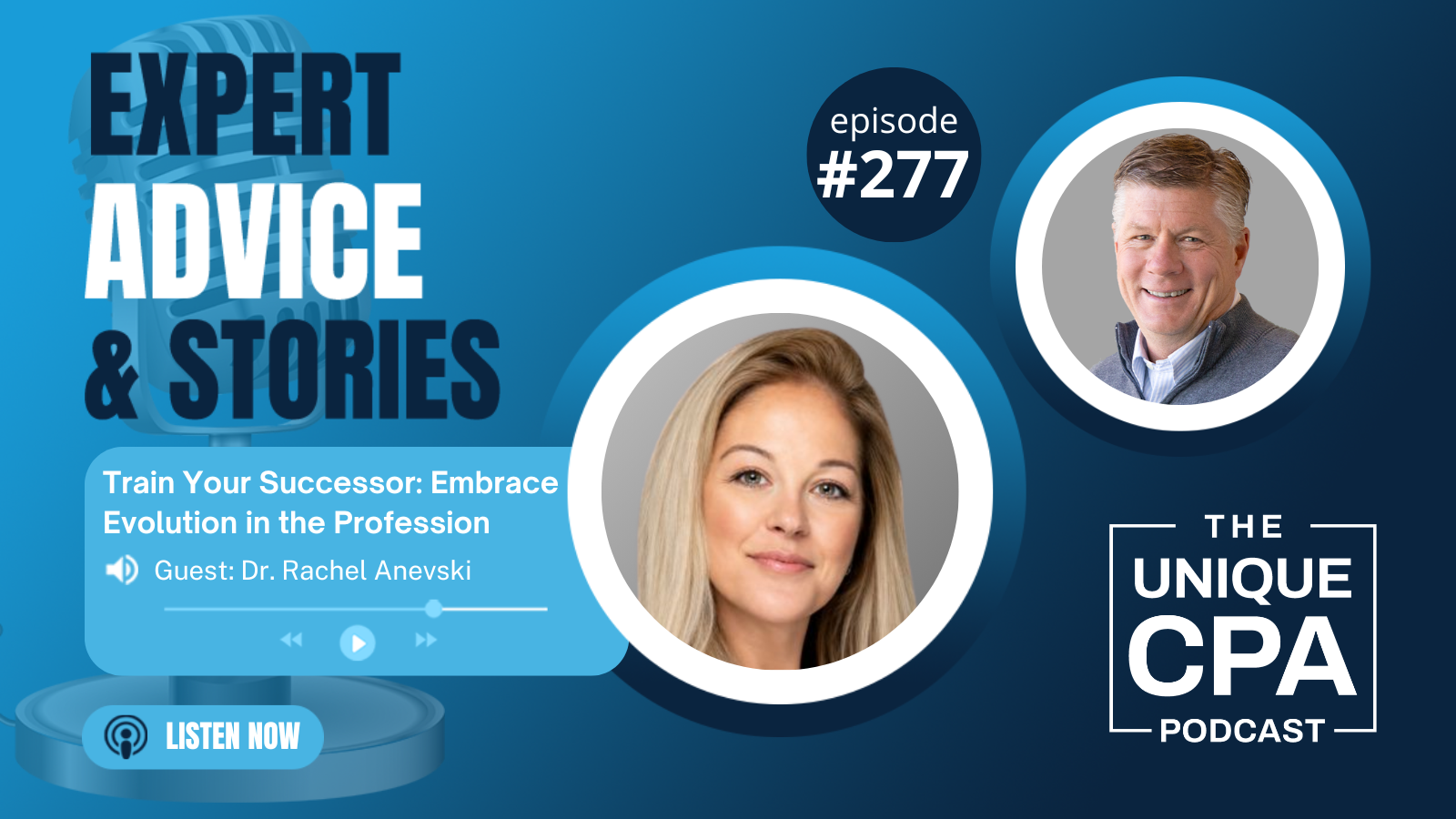
Embrace Evolution in the Profession, with Dr. Rachel Anevski
Dr. Rachel Anevski quit high school at 16 and attended three different colleges to get her bachelor’s degree, then built an independent consulting practice for 13 years before folding it into Winding River Consulting this year. On Episode 277 of The Unique CPA, she tells Randy that the move rattled her more than she expected: she fought the firm’s processes, demanded to know the reasoning behind every new system, and found herself living, even sweating out the change management principles she’d spent a career teaching others. That tension runs through her explanation as to why the accounting profession keeps failing its own people through transitions. From partners who dismiss AI because they won’t be around to see its impact, to seniors whose formative years were scrambled by a pandemic no one prepared them for, there are many pitfalls you won’t see until the ground below is approaching. She traces her philosophy on succession back to a mentor’s blunt instruction to train your replacement, and pushes back hard on the idea that partnership has to mean sacrificing a life outside the firm to earn it.
Show Transcript Hide Transcript
Today’s guest is Rachel Anevski. Rachel’s a leadership consultant, workforce strategist, speaker and founder, and CEO of Matters of Management, “MOM” for short—which I love, I love my mom too—where she has spent more than 13 years helping organizations, particularly within public accounting, strengthen leadership pipelines, improve workplace culture—sounds like stuff we’re going to want to talk about—and build sustainable operational infrastructure. Rachel recently completed her doctorate focused on leadership succession and workplace sustainability within professional service organization. One other change she had recently is she joined Winding River Consulting. We’ll talk all about this as we go, but Rachel—Dr. Rachel—welcome to The Unique CPA.
I’m so happy to be here.
Yeah, I’m happy you’re here too.
And happy to spend time with you, specifically, Randy, you’re a force in this industry, so.
I’m just having fun. I’m wearing this shirt today. I don’t think you could see it, but all I’m doing is “I want to be nice and have fun,” so.
Well, you live that motto for sure.
Yeah, it’s, I think that’s the best way to go through life. “Be nice, and have fun.” So we’re going to go, but that’s not about my slogan today. We’re going to talk about you and what you’re doing, ’cause you’re doing some amazing things. Before we even get into the things that you’re so passionate about, which is the things I read at the beginning there, these two big events in your life recently, the starting with the doctorate, tell me about that and what made you decide or what led you to this, this is the next thing I need to do in my career?
Sure. So we’ll start with that. I truly believe education is not linear, right? So you don’t need to go the same way for everyone. My oldest son just turned 21, and so when I was pregnant with him 21 years ago, oh my god, I’m getting up there, I was in college for my master’s and I had just started working in public accounting. So I was at Smolin at the time, about a $20 million firm, 120 employees. I was the director of HR there, it was my first job in public accounting. I was getting my master’s and found that I was pregnant, and that was a real big step for me because as many of my peers had done right after high school, went directly to college, and I did not do that. And so I say now my son’s 21 and he is a college student and I have a 17-year-old who’s going to college, and there’s this formula that says after high school, you have to go to college. Well, I was in 11th grade and I decided not to go to high school anymore. I quit high school.
Wow.
So, I followed the bouncing ball, if you will. I walked out of high school and I decided I was going to be a writer, a poet and a singer. Now, some of you have heard me sing, but I’m a published author now, so I did accomplish those two things, but not in the path that most people would do it. So I quit high school, and so going back, getting my high school diploma, I did 11th grade twice, going to get my bachelor’s, I was at three colleges for my bachelor’s. I have an associate’s degree in social science and a bachelor’s degree in forensic psychology. And then got married, found out I was pregnant, went and got my master’s in organizational behavior while I worked in public accounting. So that’s the backstory.
When I decided to get my doctorate, fast forward many, many years later, I had always been in this industry where CPA was, the credential was the highest point you could go, and I love working with CPAs, but I never wanted to be one. So how can I compete was my question. How can I really be in this arena with these wonderful, genius, extraordinary people that were owning businesses and people thought of them as their advisor and they were the first call, and I thought the only way I could be in the arena was with a doctorate. So it was kind of in my mind’s view that that was something I wanted to do. And so during COVID, Jessica Levin, who is the, CEO of Seven Degrees Marketing, she’s also the COO for the Abacus International, or Abacus Worldwide, which is an alliance firm. She and I had been friends for many, many years, myself on the HR and marketing side, her on the marketing and culture side. We sat down through COVID and we wrote a book together, Accounting for Times. That was during COVID, and that book really talks about—we were early—we talked about PE, we talked about ESOPs. We interviewed the very first ESOPs that happened, right before BDO announced that they were doing an ESOP. We talk in this book about rebuilding the infrastructure of firms, aligning marketing, business development, and people and leadership. It’s a lot of fun, that book, and Firm Growth Forum actually put us on stage the first year that Firm Growth Forum had a session and we talked about Accounting for Times.
And in this moment Jessica announced that she was going to get her doctorate. I knew I’d get there and I said to her, oh, you know, I have FOMO here, you know? I’ve always wanted to get my doctorate. I feel like it’s the credential that I need to be able to really kind of show up for my people, the CPA community. And she said, well, I signed up, I’m going, and I said, you first. Let me see how it goes. You go for three months and tell me if it’s really hard, if your brain is on it. I mean, I had two kids at home, a full business and, you know, doing all this stuff and she went and she’s like, “Eh, super doable Rach, you can get it done in a year.” Well, it took me three. Oh yeah, took me three years. And in that time, wrote the framework for what’s called Train Your Successor. So that’s my second book. Train Your Successor is a book about transformational leadership and human capital theory. But really what it does is it defines, and I interviewed managing partners and leaders in public accounting firms. And so it takes five frameworks of how to retain future CPA leaders in public accounting firms. Now, that was the end result of this three year stint of getting my doctorate, we could leave the difficult last name now and just be Dr. Rachel.
Dr. Rachel. Nice.
And that’s the long short of it. And the cool thing is when I went back to get my doctorate, my son had just started his bachelor’s. So we have both been in school together now twice. A fun little fact: He is getting his degree in finance and he’s hanging out in the M&A space this summer in an internship, and so all things full circle, you know that with your son who I got the pleasure to meet.
Yes. Thank you for that.
So yeah, cool stuff.
Okay, so when you were telling that story and the timing of it, I was trying to think when you and I met, was that just last year that we met at Firm Growth Forum, or was it two years ago?
Maybe two years ago. Listen, I mean, I’ve been a fan for a long time, but I had to wait to the right moments to tap you on the shoulder. But I had my moment with you, you were speaking at Firm Growth Forum, bringing us all to tears with your story. And I think, you know, I had to stop stalking you and fangirling and come up and make my presence known and transition from fangirl to friend. That was the goal.
Well I’m glad that that is what happened. It’s been great to get to know you and now we get to run into each other quite a few places. I think like three places already this year it feels like, I don’t know, six over the last few years. That’s quite a journey, that whole, when we met, and I was trying to think if I knew you pre-enrolling in your doctorate. I think you were in it when we originally met, is what I recall. But then in this whole thing, just recently you did another transition from, well, first you went from non-doctor to doctor, and now you went from your own firm working for yourself completely. And Winding River Consulting, my friends, David and Gary. And tell us about that transition.
Yeah. So, I have this thing I do where I pay really close attention to the consultants in the profession and have done that for the larger portion of my career. I think I’ve always felt aligned with wanting to do what I do for as many firms as possible, and I think that that’s the thread all consultants kind of land on. We found our talent and we want to give it away. It’s, you know, it’s kind of the philosophy of what we do. So Gary Shamis was one of those early people that I had noticed in the industry, and I remember telling the managing partners that I had worked for very closely, Ted and Henry that we should go to this conference, Winning is Everything, Gary Shamis’ conference. And they brought me a lot of places, a lot of people thought I was a partner very early on in my career. I was never a partner at an accounting firm. I tried. But, you know, I had wanted to do this. And then I spent 13 years with Matters of Management. The acronym for MOM just kind of happened to be that way. But M Squared was really the forefront of it. And I had spent all of this time kind of watching and waiting and being a solopreneur, doing great work, right? So doing, you know, M&A support, executive coaching executive search, HR consulting, and consulting, growing the infrastructure of accounting firms. So I stayed really in it, but I never got to go to Winning is Everything.
And so fast forward to, maybe last year, this time at Engage and I kept bumping into Brian Baja, who had just joined Winding River Consulting. He had said to me, you know, I read your book and you’re really interesting, and I just joined Winding River and we’re expanding and we’re growing and they’re transitioning there. Would you ever consider, and I said, say no more. I’m in. You don’t have to even say what I consider. I’m in. You know, through the years there were a couple of consulting firms that were of very much interest to me, and I think being on my own for all of that time, 13 years, and I wear the 13 on my neck. I don’t know if you can see, I wear a little 13 here. It’s our family number, my son’s jersey numbers, my grandfather’s number, and my number and the years I’ve spent at Matters of Management and the years that you go to school, right? So 13, it’s just a unique number.
It’s not an unlucky number, then.
Not for me, never was. But I was reaching the 13th year and so I knew that the timing was right to move. And like I said, there were other consulting firms that I had considered through the years. I won’t say who they are ’cause I love them all equally. I believe in the abundance mindset that there’s plenty of opportunity for all of us. But Brian was really engaging, and we had a couple really great chats. I think that the alignment of coming to Winding River and the timing really made sense for all of us. Not to say that it didn’t go without challenge, I mean, anytime you bring a new person into the mix, there’s growing pains and learning each other and all of that—and here I am 13 years by myself. I talk a lot about change management and I hadn’t experienced it in a long time. So I needed to just really immerse myself to be able to talk confidently to this profession about what change feels like, how you live in it. I needed to do it. And so, while Matters of Management is still in the background, I think you know that you always have your first love in business. Gary Shamis’ Winning is Everything, his first love in business, you know that thing that you do. I am a hundred percent committed to Winding River. The work that we are doing as a team and individually is something that I’m proud of. I love these guys and girls. I mean, we keep growing. I just brought on another consultant in marketing, so this is a very cool thing. I’m super excited to be here. And doing the work on a larger scale, right? I mean, you know, I’m over here on the east coast and people have known me for years, but now I think just a little bit different.
Yeah. And I’m glad you brought up Brian too ’cause I knew, I’ve known him for quite a while and I knew he recently joined that team too. Gary and David, and now you are all guests on the show at some point. I know we might have to get Brian on here too.
He would love it.
Couple things I want to talk about, because there’s so many things that you’re passionate about, but change management you just mentioned, it wasn’t one I was going to bring up, but I want to talk about briefly ’cause I’m going to probably ask for your help with me. I’m currently in a change situation. I think, some people know this, after 19 years of being the founder, co-founder of Tri-Merit, I decided at the end of July, I am going to step away from that role and lean in solely to my, whatever it is I do: speak, advise, hang out with people.
Be nice and have fun.
Be nice and have fun. There you go. But not necessarily for me, but for people, change is so scary. And for me, this is a time where it’s not scary. I’m super excited, but I’m just trying to figure out what it is I’m doing and how to define it. But let’s forget about what I’m doing right now. Just in general: There is so much change going on in the accounting profession right now, I think more than ever. You can say this at any point in time, but I think you can’t say that it’s ever been more than it is right now. And people are freaked out about it. People are like, you know, hey, you know, if you are my age, which is 64, you don’t want to deal with it, at least I’m seeing people in the profession, if you’re younger, you’re going to have to deal with how do you go and advise people that, hey, this is something you’re going to have to deal with and let’s just make it as pain-free as possible, or just embrace it, or what is the, how do you work with change management?
So that’s an excellent question and I think it’s a question a lot of people are asking themselves, and I think that there’s a holistic question in there that’s important on a one to one, so the mirror of yourselves question that is, what is your relationship to change? That’s the first question. And outside of it being industry, just look at the person itself. And so when I ask this, and you know, I speak about this topic a lot, when I ask this of people, what is your relationship to change? I encourage them to start thinking about when the last time they actually wore a change was. And I’m talking major change, not just like a software change or AI coming into our practices, like when was the last time you got a new dog, moved your home, left the city, lost a relative, got divorced, got married, had a child? These are the changes. And so really in our lives, we only have a handful of major change. And so it’s a fight or flight decision in our bodies, this is the psychology of it. And when I say psychological safety, that needs to be present to be there. And so that’s not, you know, to be able to grow through change. And I like to use some psychology terms like Johari Window, like how people view you, how you view yourself during transition. Because you don’t really know until you have to. The profession has had a couple of disasters and a couple of changes that have been forced upon them. You mentioned, you know, what change might look like to someone who’s 64 or an exiting person from, you know, we hear a lot, AI is coming in, but the top shelf of our firms is saying, well, I really don’t care about it because I’m not going to be here when it really affects the people. That’s not true, by the way.
Yeah, I agree.
And you know, then there’s this community of people that we’re forgetting about, our senior level staff and our seniors, people that are in it between three and five years had change—COVID—happen to them in a profound moment when their cerebral cortex was growing, right? So like they had a forced change, so trauma happened to them in change while they were growing and learning. So we’re failing to recognize that those are the people that we need most to change, and those are the people that are actually averse to change. That’s the very first time we’ve had this level of community in our firms. We always thought that they just did what we said. But they’re averse to change because it was forced on them, so it’s fear for them. It’s, I don’t want to do what somebody’s making me do. I don’t want to be forced into that where I have to be X anymore. We’re not addressing that, I think, enough in this profession.
I think that’s going to be our biggest stumbling block. But change management is physical, it is emotional, it’s what we’re hardwired to understand and everybody, every unique individual comes to work with a different set of experiences on how they live through change. And so it’s almost like you need an IO executive, an industrial organizational psychologist in your firms to help you move through this. This would be a great time to borrow—I say borrow as a word that I’m addicted to lately, there’s build, buy, and there’s borrow—I think firms need to borrow genius in this area, specifically to help their firm move through this moment in time and to the point of an individual transitioning, I have had the pleasure in my role in executive recruitment or placement or just a transition expert, if you will, to work with individuals on their own belief system and their ability to align with something new. Newness can be exciting. It’s just you have to rewire the brain to think so. It’s hard. It’s hard. I fought. Coming to Winding River, I fought every organizational norm that they had ’cause it didn’t sit right with me. I needed to understand the why, like, prove it to me. Like why do I have to enter the data? What for? You know, I’m sure these guys were like, what did we do? Why did we bring the solo practitioner on board? She doesn’t want to do anything we’re asking. And I did, I wanted to do all the stuff. It just felt like I was wearing a Halloween costume instead of what felt comfortable and normal, and it takes some time. It’s a behavioral modification, just like smoking cessation or learning to go to the gym, change management is tough.
Yeah, it is. And what you were just saying when you were just saying that I could completely see that you’re in there and questioning these things because, and I really appreciate this. When you’re in a session and there’s open for questions, you’re always the one asking a question, and I know me as a presenter and appreciate that you are not even just asking a question, maybe even questioning some of the topics that are being discussed. So I think that’s great. I’m going to take what we just said there because we’re talking about change, and tell me the title of your second book again.
Sure. Train Your Successor.
That’s what I was going to get at. So that’s change as well. So succession planning, that’s one of the things you enjoy dealing with, talking about advising on, consulting with. And so how do you train your successor within an organization?
Yeah, so let first say that Ted Dudek was the managing partner that I had the unique and lucky experience to work under. I got to work for Ted for ten years and he was the type of managing partner that truly believed this philosophy. And these were his words that he has allowed me the privilege of using. When I wrote the book, it was with him in mind, very simple topic on independence, how to maintain independence. So I had the opportunity to work for two distinctly different managing partners, Ted, being one, the second was Joel Cooperman, who I’m certain most people know in the industry, Citrin Cooperman. I got to work for Joel for a hot minute, one full year, but ten years or so with Ted Dudek, and he would talk about the perpetuation of the firm, and independence and never wanting to be purchased, you know, or merge into something else, wanting to stay the course. So, of course, my heart belongs to the independent firm, but he would say something very simple and it was just so obvious: Train your successor. If you are a partner here, or you are a senior manager here, find someone that you can give all of your experience to, and you will be able to move forward. It was a decision on delegation. It was a decision on leadership. It was a decision on training, a decision on mentorship and coaching. These were the topics he was talking about. I mean, I see them in a more academic way than he did. He talked to us like he was your soccer coach and he was building the team, first 11 and how you moved through this. And so “Train Your Successor” were his words and he’s now retired. But I called him when I finished the book and I said, Ted, can you write me a forward and can I use the title of Train Your Successor, there was no one in professional services or there was no trademark on the verbiage “Train Your Successor.” So I own it now.
Oh, nice.
I own the trademark of Train Your Successor. And it really is a methodology. Five pillars of framework to retain future CPAs, future CPA leaders in firms. It was really remarkable interviewing managing partners across the country and asking them the probing questions of how they were going to get people to want to be partners like them, and how they were going to, you know, move through this time where they could maintain their independence and stay successful.
Yeah. And then that, what you just said, train them or inspire them to be partners, that’s something that’s not as important to some people coming into the profession these days, at least from what I hear, is that partnership track. Does that make it tougher to train your successor or there still have that pool to choose from? Or is it almost training people what the partnership role means? Is there anything that you deal with that I guess, on motivating people, I don’t know if even that’s the right question. Should you motivate people to be partners?
Well, I think that you should motivate people to be leaders.
Okay.
And I think that ownership and partnerships, that model should be fluid in our firms. You know, and I think that my, you know, my partner Brian Baha talks a lot about strategic optionality and having these, the different designs of our firms. Even Jessica and I talked about it, in different structures of firms now. I don’t think we’re locked into one specific way in which we have to move through it. You don’t have to be just a partnership and the success of your firm is determined upon how many partners you have.
I agree.
That model, I think, doesn’t need to exist anymore. Some variation of it, I mean, I talk to firms all the time that are very traditional. So when I talk about 80/20 rule, you know, the Pareto rule there, there’s still a significant amount of traditional accounting firms out there functioning as a traditional model and doing rather well, making money and living it up. But I think for young professionals, when I speak to young professionals, what you hear is that they want to learn, they want to lean in, they want some flexibilities, they want to be ownership level early on. It does not look like the partnership model that we have narrated as this doom and gloom. I mean, you know, it’s not real sexy to be a partner that works 2 billion hours and doesn’t see their family. That’s not what, you know, the young professionals want. I used to say to the partners, it’s good to be the king. Why aren’t you talking about, it’s good to be the king? In some ways it’s good to be the queen. But I think that it’s important to impress upon young professionals access to significant business owners, to being able to spend time with people who have built and created generational wealth, and that’s what they want access to. They don’t necessarily want access to what it looks like to sit at a desk and, you know, stay there forever. So I think that story needs to change, the narration, because there are some really amazing things and reasons why you would want to own a portion of this great thing.
Yep. I agree completely. And I like that that change the narrative, change the story. It changed the—well, it actually changed behavior too for some leaders out there, that are sitting at their desk for 80, 100 a week and brag about it. “Hey, look what I did.” So that’s something that has to change. Let me do another transition, ’cause you said a couple things that made me think of something else. You said your heart belongs to the independent firms. You mentioned earlier, and then you also said you started talking about 80/20 rule. And I know we’ve talked before about how you think consultants out there, what you see as consultants are spending, you know, most of their time with that 20% of the firms that are probably having the biggest impact on change right now, rather than the 80% that are doing the whole traditional, “true” public accounting. So tell me what you mean by that, and is that a concern or is it a positive, a negative, or what are you looking to do?
Well, and by the way, I think that PE plays a beautiful role in the story and history of the public accounting universe. I mean, it’s a hundred year old industry, profession, however you want to define it. And so I think that there’s a time and place as it sat in with the medical industry and, you know, other industries historically. But I do believe that this amount of change that’s happening in the industry is really affecting a small percentage of firms. But when we’re at these conferences and leaders are showing up, we’re having the same talk over and over again. So our friend, Seth Fineberg just put out a really interesting observation coming out of Firm Growth Forum that last year the talks were really all about PE and this year the talks were really all about AI. I’m grateful that I’m getting to go to this conference, I don’t know if you’ve heard of it, BTG? Bridging the Gap. We likely won’t talk about much about that.
Yeah!
But you see how it’s like these themes and they take over. The conversations, but there’s so many other things that are happening: skill stack, bringing in different types of people into our firms, workforce redesign, psychological safety, wellness. You know, there’s so much that we need to be talking about, but it feels like we’re only talking about one or two things, and those one or two things, the implementers of those one or two things are a small percentage of firms. The other firms are a lot like, let’s hurry up and wait and let’s see what other people are doing. Let them make the mistakes first. And this is what happens also on that change continuum curve, right? You have like this bell curve of people, the early adopters and the people that kind of wait around and then you know, this bell curve. So when I say that there’s 80% of firms that are traditional accounting firms, still looking for the well-rounded accountant, and then there are like two to five firms that have started the creation of new AI jobs, the senior AI accountant, right? The chief pricing officer that oversees a variety of AI agents. There’s only a few firms doing this. And so how much is that actually influencing everybody else? We really need to be talking about what is top of mind for the majority of people instead of just the hot topic of the moment.
Alright, so now I understand what we’re talking about there—I appreciate that. I think I have some awkward transitions right now, but I am going to do it because it is an easy one. Because you mentioned BTG and I’d like to talk about that before I do though, because when you said the bell curve and the early adopters, that’s actually when the first year of BTG, whether I subconsciously or consciously knew this, I hand invited all these people who I knew were the early adopters, the ones that were okay with change, with trying something new. And so I think those early adopters for me, for BTG, are the ones that then got the word out, because they came, they loved it. We had 174 the first year. We went to 214 the second year and 349 last year because the people that weren’t the early adopters are now having the FOMO of, okay, yes, look at all the fun people are having. And so I was equating what you were saying to what I’ve lived through from this standpoint, with BTG. But that whole diatribe there was to get to the point of, you’ll be speaking at BTG this year. Would you go through a few minutes of what you’ll be discussing at the conference?
Yeah. So I don’t want to give it all away.
No, a few minutes.
Because this was such an extraordinary experience for me to create the slide deck. And it’s almost done, I sent it in actually this week. One of the things that I love to do is to create a training plan or a speech. I really love this. I wish I was just paid to do that and nothing else, because it takes my heart and my mind and myself all kind of come together and what I want to talk about, and there are professional speakers that take one topic and cut and paste and, you know, really just speak about one thing over and over and over again. I’m not like that. I like that it’s very unique to the people that are in the audience. And so when I wrote this slide deck, it was just such a profound experience, and so when I put in my request to speak at BTG, it was important for me that it hit home for you. And I think I called you one day, you were going to a stretch event for yourself.
Yeah!
I remember the visual. I said, oh, you’re going to be Gumby-fied, right? Like, you’re going to be, it turned into Gumby for the moment, and I wanted to just hear from you what was important for you because I wanted to make sure that I got there and I did a good job. So came up with the mind, the heart, the gut connection, and how leading through chaos could work together. So when I put out the moment, I have a couple of friends in the industry that I wanted to put together and put on stage. And so what we’re doing for your session, I’m talking about an experience that I went through that I don’t talk about very frequently. It was a really profound experience. I’m going to mention it quickly, but I will go deep dive in your session. I’ll use this as a teaser. We were retiring a partner at the firm that I was the HR director for, and it went in a direction that no one was prepared for. I’ll leave it there.
Alright. Sounds like chaos, maybe.
Like chaos. And it was one of those moments where you had to react, like all your senses, fight or flight. What do you do in this moment of safety and protection and how do you do all this stuff? So that’s where it starts. And we go through Jessica Levin, we’ll talk about ADHD and how leaders lead with ADHD and women in the workplace. So there’s menopause showing up there. And so these are coming in through not your traditional panel, these are video excerpts of these leaders. So Jessica will have her moment where she talks about this, and I’ll tie it into leadership, and we have a mindful expert, someone who does wellness in mindfulness, and then we have a registered dietician who gamifies health and nutrition in public accounting firms. And so she’s talking about how the release of sugar and the influx of peptides, how that is changing the landscape of who we are, five generations in the workplace and leading through all of this. And so I will overlay it with some transitions and some recognition that in every generation there is a disaster or a change in the business model where we are forced to lead and show up. And so I’m hoping to take you all on a journey through this session. I’m so excited about it. I really truly am.
Well, I’m going to have to ask Gisela, my assistant to make sure I have free time at that. When you’re speaking. It’s hard for me to get into many sessions just ’cause it’s such go, go, go. But I would love to get in there. If nothing else, I’ll see the video of it, but I’m hoping I can get in there.
Yeah, I mean, you have such good speakers, like I’m even having FOMO for myself. I’m lined up with people that I would love to sit in and watch, you know?
Well, we’re going to tape every session this year, so we should have access to all those. I made sure this year, because last year, I guess we didn’t, I didn’t realize that. This year I made sure we’re going to be having every session be videoed? Taped? I don’t even know. Do you say tape anymore? It’s not taped—recorded! That’s the word. They’re going to be recorded. So, alright, so the final two questions, are you ready? We just talked about leadership and psychological safety and training your successor and all these cool things that I think are super important for the profession. But when you’re not thinking about the profession, what are your outside of work passions, what do you love doing? What defines you?
So I think that my give back to the community is what really defines me and something that’s so important to me. My mom passed away young and she and my grandfather, both of them had heart issues. So it’s always been something in the family. But both of them spent their free time working with children in some capacity. My grandfather was a community leader, my mom took children that needed extra help, and so she cared for them. And so I’ve always felt like I wanted to do that in some capacity. So I’m a court appointed special advocate for children. So in my free time I get to, I’m assigned a family or a child that I get to show up for on an educational basis or in family court. And so I believe in that work. I think even my children watching me do this through the years have recognized the diversity and the privilege that is out there, or the lack thereof. I mean, just, you know, really kind of understanding where we sit in the world.
And then early on in my career, I worked with people with autism. And I always felt that people with autism had a unique, special power, a superpower. They were able to have something about themselves that was either exacerbated or that was better than, I mean, I’ve seen calendar savants, I’ve seen Disney savants, I’ve seen some real uniqueness and at the same time, their social interactions have had a hiccup. So I get the great privilege of doing some pro bono work for a cafe that employs people with autism, and I get to develop their infrastructure and their training models and so that I spend my time with, and those are the things that I’m truly passionate about. These two things that give back to children and people with autism. And when I’m not doing that, I’m hanging out with my dog. His name is Hugh Hefner, he’s super cool. So those are my things,
What kind of dog?
So Huey is a Catahoula. I mean, I’d never heard of a Catula before.
Me neither.
They come from like Alabama and Tennessee and they corral boars. He’s just super, super cute and wants to talk with me every day and play ball, but never bring me back the ball.
Yeah, we’ve had dogs like that. People probably won’t hear it on this recording, but my dog was barking during part of our conversation, which is a, he is a rescue, he is an Australian shepherd and an Australian cattle dog or Blue Heeler mix. So a lot of energy.
Yeah. Huey kind of looks a little bit like that.
I was wondering that.
Your dog is gorgeous. I mean, Huey is a, a lot of people think he, I mean, he’s a hound, right? So like, that’s the first thing. But people have asked if he was that breed. I’m going to send you a picture. He’s, yeah, he is really a lady killer. He’s a gorgeous dog.
Nice, nice. Alright. And then the last question, if people want to hear more about what you’re doing, get copies of the book, follow you on the conference circuit, where would they look?
Sure. So I’m doing this between now and the next couple of months: I’m speaking at a variety of different places and I’m showing up at the ones that I’m not speaking at. But I will be for a power jaunt at AICPA Engage. I do hang out and love the people at BDO, so, I’ll be speaking at some of those BDO conferences. As you know, BTG, looking forward to that conference. I love that I’m going to be with Upstream Academy for their 25th leadership conference, so that’s super cool. I think, you know, to, again, this kind of abundance mentality, we’re all doing the good work with this common theme of helping accounting firms really grow and lean into all of this change. So there’s that. Some of the things I really love to do: I love to build on community and communication, and communication is the rise of what we need through all of this. And the different workplace models from hybrid to remote to onsite and the different generations being in the workplace and all of the change, having a common language is really important. So I think that that’s, you know, that’s really kind of my charge, if you will, right now in the community. That’s some of the good work that I’m doing and, you know, consulting and advising, managing partners and leaders of the firms on what to look and where to look more. I mentioned earlier the word “borrow.” I do think this is a great time to borrow the genius of an expert of a consultant, of an advisor that is around so many collective firms. You’re just closer to the answer than individual firms are at the moment.
Yep. You were just mentioning Upstream, I was just going to say, Jeremy’s going to be on the podcast soon, so I’ll be talking to him. I’ll have to mention that we talked recently. Alright. Well, Dr. Rachel, thank you so much for being on this episode of The Unique CPA and I look forward to seeing you around soon if nothing else, and I’ll see you at BTG, but hopefully somewhere else on the circuit. Again, thanks for being here today.
Thank you.
About the Guest
Dr. Rachel Anevski is a leadership consultant, workforce strategist, speaker, and Founder & CEO of Matters of Management (MOM). For over thirteen years she has helped organizations primarily within public accounting to strengthen leadership pipelines, improve workplace culture, and build sustainable operational infrastructures. In her work with Winding River Consulting, she supports firms nationwide in leadership development, team performance, and organizational planning, with a focus on helping firms build leaders from within.
Rachel recently completed her doctorate in leadership succession and workforce sustainability, which led to her book Train Your Successor, a practical roadmap for perpetuating institutional knowledge and preparing future leaders. Her expertise spans DISC and behavioral communication, workplace culture transformation, women’s leadership, and building psychologically safe yet accountable organizations.
Outside of work, Rachel supports Ethan & The Bean, a nonprofit creating employment for neurodiverse individuals, and serves as a Court Appointed Special Advocate (CASA) for vulnerable children.
Meet the Hosts
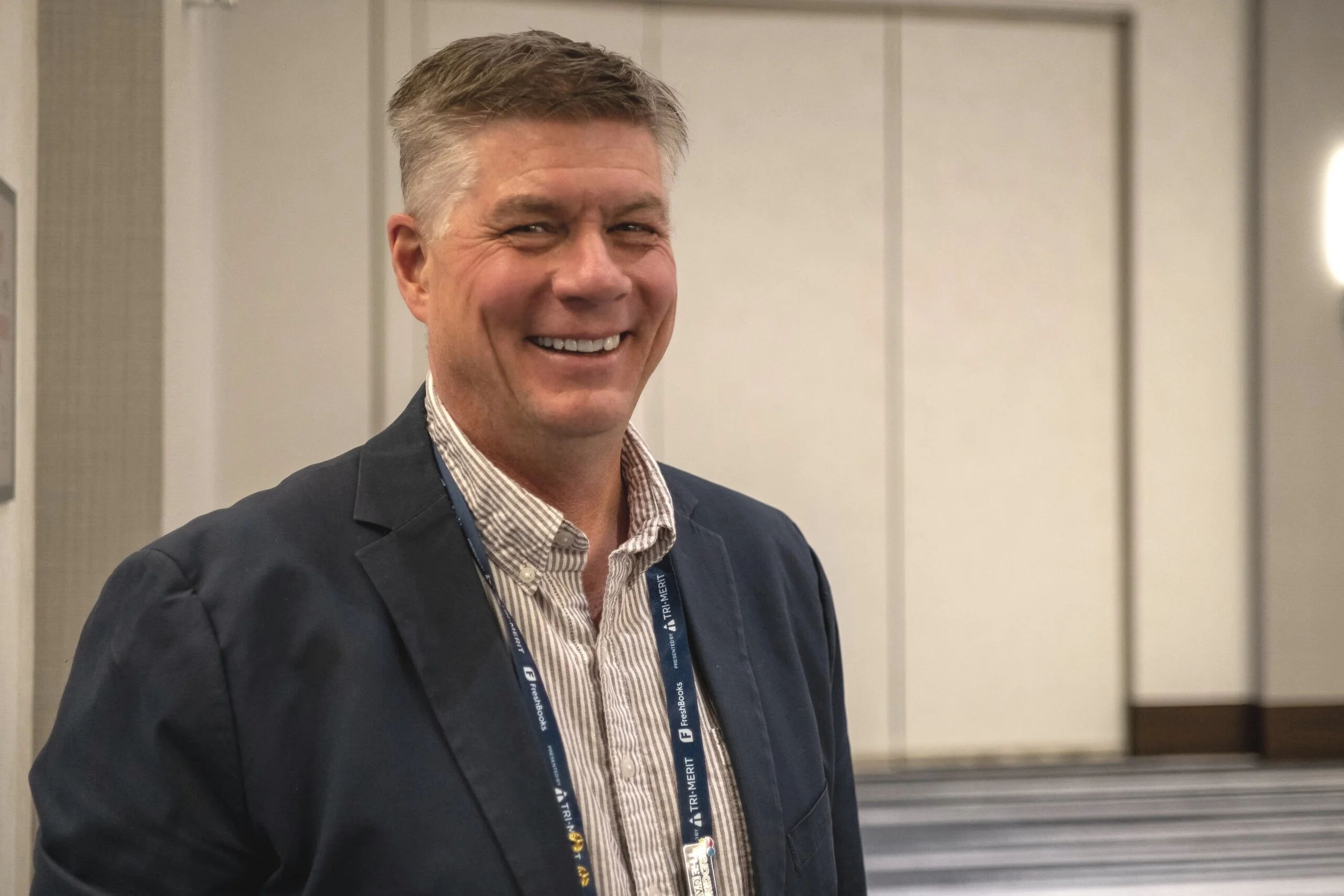
Randy Crabtree, co-founder and partner of Tri-Merit Specialty Tax Professionals, is a widely followed author, lecturer and podcast host for the accounting profession. Since 2019, he has hosted the The Unique CPA podcast, which ranks among the world’s 5% most popular programs (Source: Listen Notes). You can find articles from Randy in Accounting Today’s “Voices” column and the AICPA Tax Advisor, and he is a regular presenter at conferences and virtual training events hosted by CPAmerica, Prime Global, Leading Edge Alliance (LEA), Allinial Global and several state CPA societies. Randy also provides continuing professional education to Top 100 CPA firms across the country.
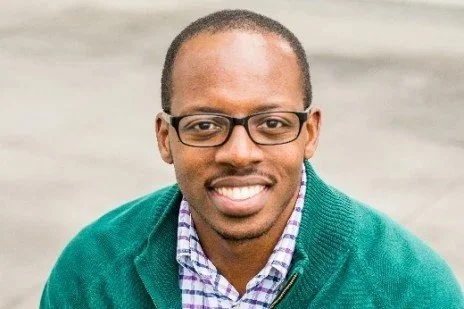
Terrell Turner is a 3x nationally ranked CPA, 2x Top 20 Global Finance Influencer. He is the founder of the TLTurner Group, which has been recognized in NYC Times Square and the NY Times as a top accounting and CFO firm that specializes in supporting law firms. Outside of running an accounting firm, Terrell hosts multiple vlogs and podcasts in addition to co-hosting The Unique CPA. Terrell is also a speaker and a content creator who regularly hosts and collaborates on video and audio content projects with multi-billion dollar corporations, bar associations, universities, and non-profit organizations.