
One Stop, Full Access
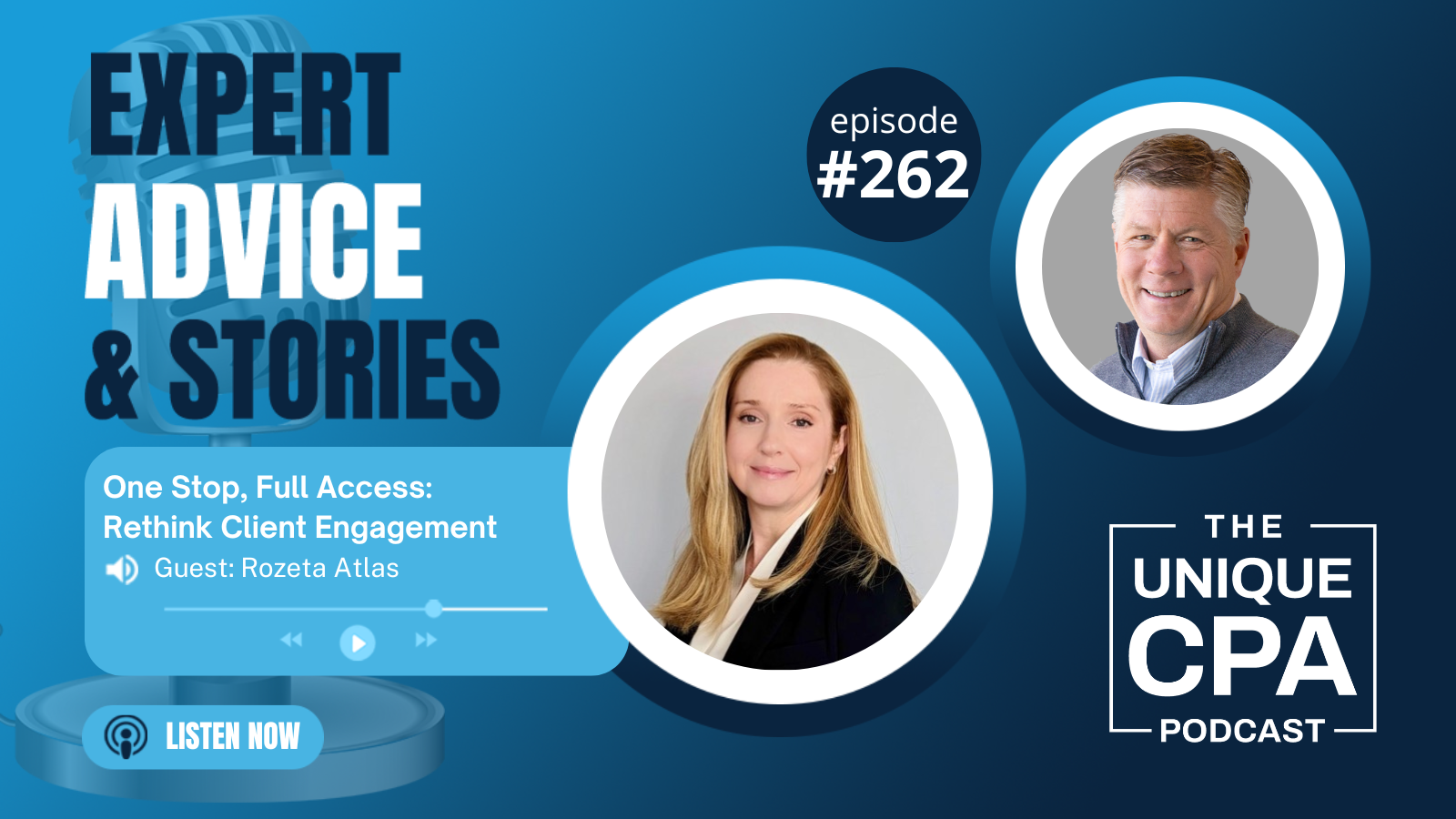
Rethink Client Engagement with Rozeta Atlas
Support for this episode comes from BILL. Simplify your workflows and accelerate your growth with BILL’s Accountant Console. Take a demo today at BILL.com/uniquecpa for a $250 gift card – terms apply.
Recorded on April 15th, a day Randy describes as one he’s never been fond of, and now has even more reason to dread, is this conversation with Rozeta Atlas, on Episode 262 of The Unique CPA. The Director of Product Enablement and Adoption at HubSync, Rozeta cuts right to the heart of why busy season feels so broken, explaining that the problem isn’t just the volume of work, but also that progress is invisible to clients. They assume nothing is happening, and since accountants are buried under their own huge pile of returns, the communication gap between the two is like an ouroboros of failings. Rozeta draws on her background moving from tax technical work into firm operations to make the case that technology alone isn’t the fix, because process has to come first. She's also clear that the window to fix things for next year is already open: Extended returns due in September and October mean there’s still time to standardize, identify the gaps, and layer in the right tools before the next wave hits.
Show Transcript Hide Transcript
Today’s guest is Rozeta Atlas. Rozeta is the Director of Product Enablement and Adoption at HubSync, where she helps firms rethink how they deliver work, communicate with clients, and ultimately create a better experience—which I like—through smarter processes and better adoption of technology. Rozeta, welcome to The Unique CPA.
Thanks so much, Randy. Happy to be here.
Yeah, I’m excited to have this conversation today. But before we even get into that, I know there’s a little more to your background than I just mentioned. Do you want to expand on your history in this profession and anything else that comes to mind?
Oh yeah, I’d be happy to. It’s kind of been an evolution of a career. Started out as what I would even refer to as a “tax nerd.” Spent a lot of years in the industry, both in public accounting and working in house, and some big corporations. Most recently I spent time in one of the accounting firms focusing on the operational side of tax, so I had to switch from the tax technical onto the operations. And so I’ve been here with HubSync now for almost a year, and as you said, my focus has been around product enablement and adoption, and that focuses really on the use of technology in the most optimal way. A lot of clients implement technology and don’t really use it to its full extent, they don’t reap all the benefits from that technology. And so there’s a lack of adoption in some cases for clients because they’re just not able to communicate or train their people optimally so that they really get the biggest bang for their buck when they’re using technology. So in this case, I do that for our HubSync platform.
Nice. And before we even get into this conversation, why don’t you give us a little background on HubSync?
So HubSync is actually a really cool organization. I hadn’t heard about it in the industry, originally. It has been around since 2019, but it was started by someone who has spent many years in the big four accounting firms, John McGowan, who recognized the fact that not just the Big Four firms need technology support, we need to help out the second tier, the smaller firms to be able to be efficient and be able to complete a lot of the work that they do quickly and efficiently. So what he did was he started the firm to be able to handle your end-to-end process when it comes to engaging your clients, preparing the work, and the ultimate delivery of the work that’s prepared. So our goal is to really create this one-stop shop for everything that services our clients.
From collections, communications, delivery. How about, I mean, when we’re talking taxes, are we talking about preparation too, or at least integration of the data into current tax software?
It’s both actually. So we’re not trying to be the only tool out there in the market, we’re able to integrate with other tools. But ideally, if you want to have the experience of a centralized process flow where you can just go in there and get everything done in one place, create your engagement letters, collect your data from your clients, whether it’s entities, through PBCs, or the organizer for your individual clients or trusts and estates, and then be able to take that data and ingest it into your calculation engine, we have work papers that we’ve even developed for our corporate and partnership clients. And so being able to take that information, run it through your tax engines, spit out the tax returns and then be able to deliver it, and when we say deliver, it’s actually a really cool process in terms of we have automation in place that allows you to get the signatures from our clients, our 8879s, then be able to release the e-file forms on their behalf and then track it. So everything with one click of a button that just takes you through the entire process. And that’s very manual typically, but that gives you the visibility into where you are in the process.
Okay. And I just want to clarify because maybe I misunderstood. You’re not building the tax preparation engine too, are you? Or you are?
The work that goes into…
Yes, that’s what I thought.
Yes, exactly.
Okay. So it still will integrate with, you know, UltraTax or Drake or, you know, Intuit products or whatever. Okay, got it. Alright. I was going to say, man, that’s a big undertaking if you’re building the tax software as well, so.
Yeah, the irony is the tax softwares out there are not capable of doing everything. So you find a lot of tax professionals need to do a lot of work outside those tools.
Yep. Alright, so let’s get into, you and I are recording on a very interesting day. It’s April 15th, this will come out in a few weeks. But we’re recording on a day where there’s a lot of accountants sitting at their desks still, unfortunately, you know, sending out extensions, still trying to gather information from clients, clients probably wondering what’s going on with their returns. And so it’s an interesting day. When you look at this day or end of tax season in general, what do you see that firms may be struggling with still and, as we speak, as they try to wrap up busy season?
Yeah, during busy season we actually see a paradox. So we see that the work is moving, returns are being prepared, extensions are being filed, but everyone feels overwhelmed. And the reason isn’t the workload alone, it’s really the lack of visibility, that transparency into what is happening. Inside the firm, teams are constantly switching context. They’re answering emails, checking spreadsheets, searching inboxes to confirm whether an extension was filed or whether a client is good for now. On the client side, they don’t see any of that progress, so from their perspective, they’re assuming that nothing’s happening. So unless they get that communication to let them know and give them the comfort that, yes, we are working on your returns, on your extensions, what they end up doing is just fill in those gaps with, you know, whatever they tend to imagine that’s actually happening.
Yeah. Would the word be paradox? It’s an issue in this time of year, which I hate tax season in general. I don’t think there should be a tax season. I think there should be a “tax year” where people can spread this out. In reality, I think they can, but I won’t go on my soapbox for this right now, I’ll stay in the conversation we’re having. But one of the issues is, and we’ve been going through lack of people coming into the profession for a while, we’re seeing an uptick right now, which is a positive thing, but you know, it’s such a truncated timeframe where these tax accountants need to get all their work done. It’s insanity to me. And so it’s this client wanting to have constant communication and know what’s going on, and it’s this tax preparer having no time to do this. I know we talked about the stat offline before we went on there, but the stat offline we were talking about is that 58% of clients feel like they’re constantly chasing their accountants to find out the status of their return. How do we get these two things to work together successfully? Where’s the sweet spot? How do we manage this process better?
So the interesting thing is that the accountants, they are tracking their own progress, but they’re tracking it in a lot of different places, right? Some are using disparate Excel files, some are using just emails to keep track of what’s going on. They’re using a lot of different methods and tools to be able to do that. But of course, that doesn’t mean that’s translating to a communication back to the client around the status, right? So the information’s being captured somewhere, but the client’s just not seeing it. So what I would say is the way that they need to kind of think about is, are there opportunities to be able to provide the visibility to their clients? And how do you do that? Usually technology is the answer, but not all firms have that centralized place where everything’s captured, everything is maintained timely. Because you also have the issue of accounts may be preparing returns, but they’re waiting until the end of preparation for all of their clients before they’ll update their statuses. So there’s also that mismatch in the timing. So there are a lot of different things that go into play, but if they’re able to capture that information, but be able to also let the client into that world to be able to see what’s going on, things would go a lot smoother.
And so when we say “capture,” like right now, let’s say someone’s working on a tax return. Obviously the tax return, you know, I don’t know how deep you can dig into a tax return, but you know, if somebody’s entered the 1099s and W-2s and all that, I don’t know if you can automate that and have that be communicated to clients, or does the tax preparer, EA, CPA, accountant, have to somehow manually communicate? Is there a way that we could start automating more of this? Again, building efficiencies into a tax practice is huge. We’ll talk about that in a minute, but so, any way that we can take the manual labor out of this for accountants. The better and the more satisfied the clients will be. So yes, how deep can we dig into this automation of communication?
So I think there are a number of factors that you can take into account. So there’s the aspect of collecting the information from the clients. So number one, you need to communicate to them what kind of data that you need from them. So how do you do that? If you can implement technology to collect that information, but also ingest it as part of the process, and allow your client to see all the steps that are happening there in that respect, then that could feed into the, “okay, now I’m in the process of preparing the tax return or the extension, and the client would know that.” Because it’s almost kind of like your Domino’s, right? When you order your pizza from Domino’s, they let you track every step of the process: We’re in preparation, we’re in process of delivering, and so on. So similar concepts, I mean, the pizza industry got it right?
No, yeah, I like that!
So if we can apply the same kind of approach with preparing the tax returns or any other, honestly, any other deliverable for a client, I don’t see it as, you know, unique to extensions or returns or anything. It’s literally anything that’s delivered to a client, having that step-by-step process that they can view online as part of your workflow. If you implement these workflows that really hold your hand in every step of the way, and then allow the visibility to your clients to see that they don’t need to see everything, you know how the sausage is made. You don’t need to show them every little piece of information. But as long as the proper information boils up to them, just so that they know, “Yes, someone’s actually working on it, I know they have a million other clients that they’re servicing, I get that, but I’m still important too, so I want to make sure I’m not forgotten.” So this is a great way to be able to accomplish that.
Alright. And so I assume HubSync does this, and I assume that’s one of the reasons we’re talking about it. And then with what HubSync does, is this a portal or is it automated email communications, or is it all of the above, or text messages?
Yeah, I mean, it’s absolutely everything. It was thought out extremely well. It’s not trying to accomplish just one thing. What we’re trying to capture is the entire end-to-end process so that your client is involved from beginning to end, so that you can actually do the work in there. But then as you’re doing it, everyone that should have the visibility actually has it. So your tax partners, your managers, everyone’s aware of where everything stands, who is now responsible for this particular step in a process, who’s coming up next to bat, and so on. But at the same time, when you’re allowing your client to have access to that same place where all of that information is being captured, this is what we’re doing with HubSync. We’re developing the workflows around that, but then we’re also creating our own workflows. So that is how I definitely recommend that work.
Alright, so let’s shift gears for a minute, just a little bit. It’s still under the same, you know, communication and data gathering and that vein. But since we are sitting on April 15th right now, which is a day that I think people who have listened to this show before have heard me say this, but it’s a day I’ve never been happy with, but it’s also a day I’m a lot less happy with now because a year ago today, our dog of ten years died at my feet, sitting at my desk, and it was not a good day. So April 15th is always going to suck to me, but not just me. I’m on multiple group chats, and today my messages are going crazy because accountants are complaining about their clients not getting the data to get extensions done, and they’ve been bugging them forever. “Do they owe taxes? Can I just hit extend? Do I need a payment? Have they verified the new bank information or is there new bank?” All this stuff that shouldn’t be waiting till today anyways. But sometimes, at least according to our stat here, maybe it’s the accountant’s fault, in my mind, a lot of times it’s the taxpayers not being communicated with as well. But you mentioned something earlier, not when we’re recording, but before we went on about just automating this extension or modernizing the extension process. How can we get past this so that this day or the week, the second week in April, is just not such a crazy time with who can we file, who do we need to extend, do we have all the data? When you say modernizing the extension process, what are we talking about?
So it does start with process though. The last thing you ever want to do is put a technology tool over a bad process. So the number one thing is you need to take a step back and assess what is your current process, where are the gaps, how do you need to fill the gaps? Once you do, then you can layer on the process. That could include things like workflow tools, as I mentioned, ways to collect the data a lot quicker, maybe allow the clients to give access to their CPA firms, ways to pull up their simple forms, W-2s, 1099s and things like that. So if there’s any way you can enable a lot of the legwork that can be done ahead of time, that’s one great way to do it. And then there’s also, you know, all the cool things that we’re doing with AI and intelligent document processing. That’s another way to mitigate the issue of the tight deadlines, and just all the work that needs to get done. Typically, you know, you have to wait until the 14th or the 15th, and then you’re slammed with all these returns you’ve got to file all at once, so you don’t want to be in that position. You want to be able to spread out the work so that you’re able to complete a lot of things ahead of time and just spread it across the busy season.
Yeah, it’s funny, when you were talking I just got another text as well. So it is an interesting day for accountants for sure. So we’re just talking about processes and automation as well. I think one of the disconnects of why we have a combination of taxpayers thinking they have to, you know, hound their accountant and accountants thinking they have to hound their taxpayers, is, for lack of a better term, the fear of change on the accountant side, the fear of technology and automation. And the reason I say this, you mentioned AI just a few minutes ago, but you know, I’m hearing more and more about AI fatigue and, you know, everybody’s hearing AI and there’s so many AI tools coming out for accountants, but it’s also just at the current time, people believe it’s not saving them time because they have to spend so much time researching and figuring out what’s best for them.
How do we get people past that fear? Because they have to. If you don’t integrate new technology today, you’re going to get passed by. You’re going to be the one that your clients are not happy with. You are going to be the one that’s going to be sitting at your desk 80 hours a week because you’ve created this mess for yourself. And so how do we get this mindset change from, I don’t have time to analyze and implement new technology, to seeing the big picture of, yes, I’m going to reduce my time to 50 hours a week at my desk during tax season, or 30, or some number, if I just can get past this fear of integrating new technology. Do you have a way that we can squelch those fears for accountants and get them to the point where they need to be, because I believe you could be so much more efficient than you are if you just lean into this technology that exists today and that’s coming down the road. Man, that was a long question, wasn’t it?
Yeah! Let’s see if I can tackle that. So I definitely see that in the market, I experienced it. I came from an accounting firm that was looking at a lot of different solutions out there, both AI-based, but also, you know, your traditional kinds of tools out there that tax professionals use. And so I definitely experienced that myself. The key here is for vendors to really approach things in a very smart way: Who can you trust, right? So it’s really a matter of making sure that the vendors are applying the AI very specific to their world. I know that’s the trend now, I see that in a lot of different vendors. For example, Thomson Reuters, you know, they’re using Copilot, they’re using AI for that, and the cool thing about them is the fact that they’re tapping into their own data sets. So all of the publications that Thomson Reuters issues, that is the basis for the responses. So we are doing the exact same thing with HubSync. Any kinds of responses are always related to the content that we produce internally, so there’s always a reference back to that. So that is the smart way to implement it. But I definitely can see why clients might be frustrated when they’re just using, you know, their Copilot, you know?
Yep, I understand. And so, you know, obviously change has to happen. Accountants have to embrace it, taxpayers have to embrace it as well. But if we were in this moment of time today, April 15th, where everybody’s frustrated whether the side you’re on is preparing or having your return prepared. What do we need to do? And I know the thing we don’t need to do is we don’t need to ignore what we just went through and just let it go again next year. There always has to be change. And so for you, what kind of advice would you give a tax preparer to prep for next year and not be surprised. Believe me, I can tell you right now, tax season’s coming again next January, so everybody knows it, but we often ignore that until we get there. So what can we do today to start prepping so that we can be a more efficient tax firm going into next year?
So certainly learn from your history, from your mistakes. Acknowledge them. Really make sure that you’re looking at things realistically and objectively, and recognize the fact that certain things may not be working well. So the key is, understand where your current state is, identify those gaps, acknowledge them, and then deal with them. In a lot of cases it revolves around the process like I said. You should never put a, you know, a technology over a bad process. So first fix the process. Who’s doing what? Are there different methods that everyone’s using? From my experience, accounting firms, each little group has their own way of tracking different things. They have their own ways of doing things, they’re all using different tools for different purposes. There’s not a consistent way to do anything. And so the key is, if you want to achieve efficiencies, one of the biggest benefits from standardization is that you can achieve that. By doing so, there are so many different benefits that you get from that. Financial benefits from better margins, for example, being able to use government sources more effectively, being able to really focus on the process itself. Once you’re done with that, then you can look at all the technologies that you could use out there to enable that process.
Nice. Process. I’m a terrible process person, so I need somebody like you to help me with that. I agree: I’m fortunate in our organization, I have people that are really good at processes, so people stay in their lanes because that’s what they like. But yeah, I completely agree: Standardizing those processes, communicating it well, and then finding the technology tools that will make those processes as efficient as possible. I mean, if you just look at it that simply, and you just did an amazing job of making it sound simple, I think it’ll make a big difference. But the key is, and I said this already, this starts now. This doesn’t start in October or November or December, it starts today. Well, that was great. It’s very timely and, again, we both will stress to anybody listening, start today, because you are post-tax season right now when you’re hearing this. So start today so that you’ll still remember what you felt like three weeks ago or whenever this is released. So start that process of processing everything today, if that makes sense.
And I would actually add that it’s not too late to start thinking about the upcoming busy season, not April 15.
Oh you’re right. Yep.
You’ve got extended returns that you still need to file that are due in September and October, so there’s still a little bit of wiggle room there, so start thinking about that now.
Awesome. That’s great advice. Alright, final two questions. First, and everybody gets this, is because we are all unique and we all have things that we enjoy. Besides for you, working with clients in HubSync and me being on the podcast or whatever else I do, when you’re not out there helping people with their processes and their technology, what do you enjoy doing for fun? What are your outside-of-work passions?
Fun? What is that? I’m very low maintenance. And this might sound cheesy, but I love to travel. When I can, I don’t get a chance to do that. I love learning about new cultures, well, existing cultures, new to me. And especially, I have a huge love of food, exotic food, interesting food, holes-in-the-wall kind of places. They kind of go hand in hand, the travel and the food. Those are my very favorite things. And I just recently moved to a different state, and so I don’t get to see my family and my friends as often, so that’s the other thing that I would love to be able to do more, but that’s something I’m very passionate about.
Nice. Well those are great outside-of-work passions, or you can even integrate those into work at times. My travel, I love traveling, but I get to travel for work a lot, so it kind of integrates those two together. And then last thing: If anybody wants to hear more about you and or HubSync and find out what you’re doing at HubSync, where would they look?
You can go to HubSync.com. There’s a lot of information about the organization and there’s also my bio in there so you guys can reach out to me through there. And I’m also on LinkedIn, Rozeta Atlas, probably the only Rozeta Atlas there, so it should be easy to find.
Yeah! Well, Rozeta, thank you so much. I really appreciate you being on The Unique CPA.
Thank you so much for having me, Randy.
About the Guest
Rozeta Atlas is the Director of Product Enablement and Adoption at HubSync, a leader in tax and accounting automation. A specialist in tax accounting and policy, focusing on how technology can modernise legacy financial systems, Rozeta leads change management strategies for top-tier CPA firms. She is instrumental in helping professional services transition from manual, fragmented processes to HubSync’s integrated, AI-driven platform. Her expertise ensures that complex tax workflows are translated into user-friendly digital experiences, allowing firms to adopt automation without operational friction.
Beyond product implementation, Rozeta is a vocal advocate for technological modernization in the industry. She has shared insights on the necessity of upgrading IRS systems and frequently speaks on the intersection of tax policy and digital transformation. Her work sits at the heart of the "Mission Control" approach, bridging the gap between sophisticated software and human-centric adoption.
Meet the Host

Randy Crabtree, co-founder and partner of Tri-Merit Specialty Tax Professionals, is a widely followed author, lecturer and podcast host for the accounting profession. Since 2019, he has hosted the The Unique CPA podcast, which ranks among the world’s 5% most popular programs (Source: Listen Notes). You can find articles from Randy in Accounting Today’s “Voices” column and the AICPA Tax Advisor, and he is a regular presenter at conferences and virtual training events hosted by CPAmerica, Prime Global, Leading Edge Alliance (LEA), Allinial Global and several state CPA societies. Randy also provides continuing professional education to Top 100 CPA firms across the country.