
When Your Strengths Become Stressors
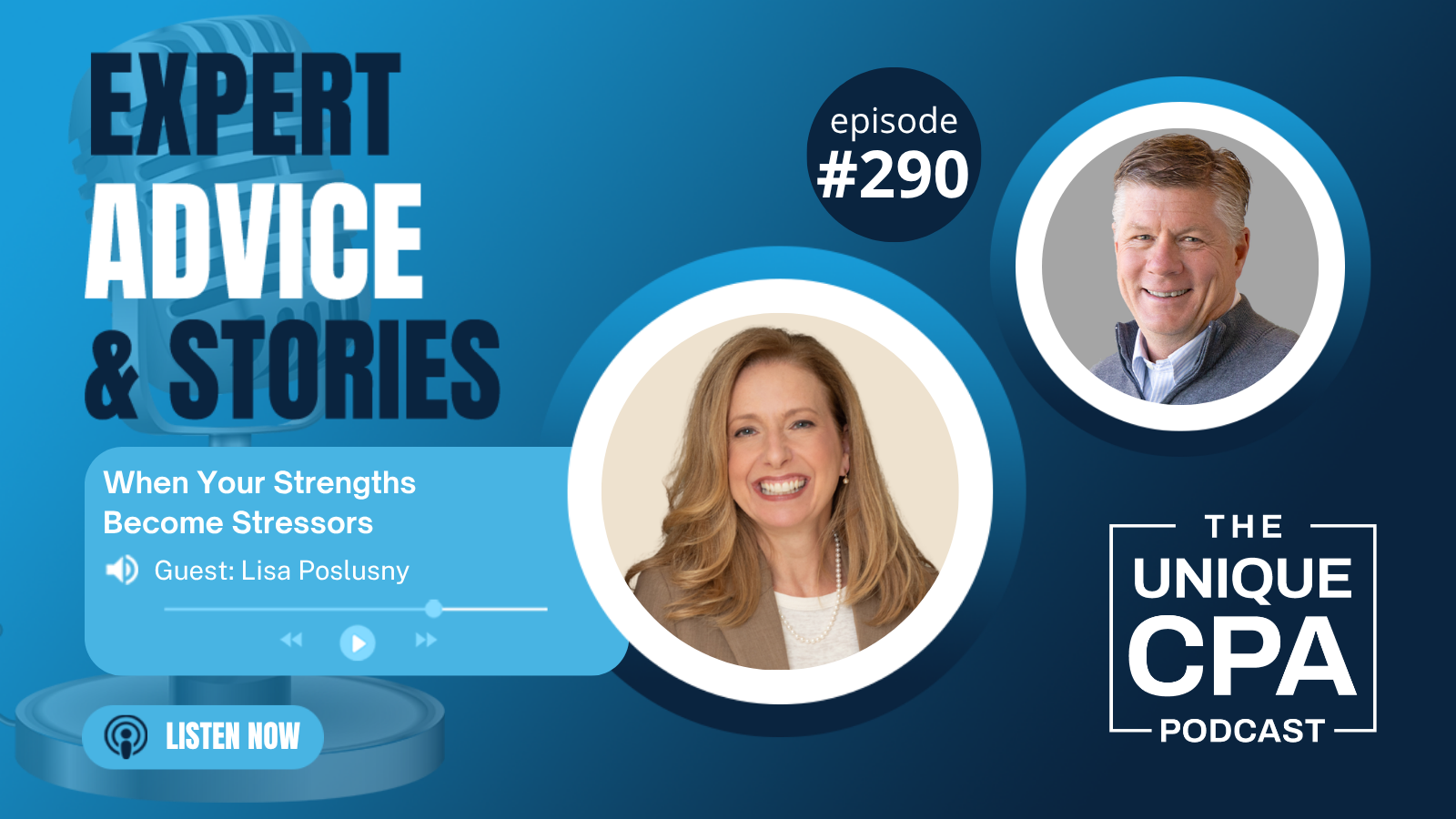
With Lisa Poslusny
After 25 years in accounting and finance, Lisa Poslusny discovered that switching careers didn’t switch off the pressure. The same overwhelm she felt juggling deadlines and deliverables followed her right into health coaching, which led her to mental fitness. On Episode 290 of The Unique CPA, she explains that mental fitness is not mere positive thinking, but rather, the ability to catch the unhelpful thought patterns that drive automatic reactions. Randy and Lisa dig into how the strengths that make accountants great, like high standards, analytical thinking, having answers for clients, being a trusted advisor, and so forth, can spill over into perfectionism and self-judgment that drain energy without producing better work. Lisa walks through what those patterns look like in real moments, like the accountant who glances at a client email at eight o’clock and feels compelled to respond instantly. But there is a simple alternative: ten seconds of focused attention to shift your brain out of stress mode.
Show Transcript Hide Transcript
Joining me today is Lisa Poslusny. Lisa is a national board certified health and wellness coach and mental fitness coach who spent 25 years in accounting and finance. She now helps accounting and finance professionals handle pressure without sacrificing their energy, wellbeing, or relationships. Today we’re going to talk about many things, among one, which will be, probably—we’ll see where the conversation goes—is why work can feel harder than it needs to, and how strengths that helped us be successful can sometimes work against us. Lisa, welcome to The Unique CPA.
Randy, thanks so much for having me.
Yeah. Well, this is a topic I think anybody who’s listening to The Unique CPA Podcast knows, oh, this sounds like a topic that Randy would like to talk about. So I definitely want to get into this. But before we do, talk about what you’re doing today and what you’re seeing in accounting and finance, I’d like to get a little background going from 25 years in accounting and finance to now being a wellness coach and mental fitness coach. Give me this career path and how you got here.
Sure. Well, I started out in public accounting after graduating, so I did that for I guess four or five years, made manager and then, as many of us do, wound up working for one of my clients. And really from that point on, I was in the mortgage industry in different capacities, working in finance, accounting, different projects over the years. And most of my career I was at PHH Mortgage, that was almost 20 years right there. So, yeah, I mean, I did a lot of things. I really enjoyed a lot of the work, but it was tough. It was a tough run for me. Finally, I had the opportunity, probably the last five years of my career, I was really wanting to do something different, and I had the opportunity to make a switch, and I’ve always been interested in health and wellness. I thought, oh, yeah, this is great. I’m going to just completely do a 180 here, I’m going to tell people how to eat, how to work out, it’s going to be great, and all this stress and pressure that I’m feeling and juggling a billion different things and not feeling like I’m doing any of them particularly well, that’s just all going to melt away.
And I quickly learned that circumstances aren’t the whole story, and some of the same pressure feelings and overwhelm that I had experienced over the years, they followed me right into my next completely different career. Very early into my coaching experience, I was introduced to mental fitness, and I found that not only was it the key that I wish I had found years ago, but it was really exactly what the clients who I was working with needed as well. And the more and more I practice it, the more I believe it’s a skill that everybody should really consider building just like, as if I was going to say, you know what, everybody should kind of get to the gym and lift some weights and do some cardio. I mean, it needs to feel just as second nature as that, in my opinion. And now I’m just really thrilled to be able to bring these skills and strategies to the same profession that I really, in many, many ways enjoyed over the years, just felt like I was missing a piece of how to really operate through it well.
Yep. I want to go into one thing you just said there because you talked about mental fitness. And so when we talk about mental fitness, I mean, you equate it to like exercise and that. But I mean, I think people listening might think, well, what does that mean? It’s not just supposed to be more positive. What am I supposed to do? How do I become mentally fit? So what does that path look like?
Yeah. Well, I’m glad you said positive, right? Because that is, it’s not just about positive thinking, right? It’s more than that. It is the ability to respond to challenges, to work and life challenges, with calm, clearheaded thoughts and actions, rather than these automatic reactions that come from stress, fear, frustration, self-judgment is a big one. And it’s really about having awareness of what our own internal thought patterns are adding to our experience, and learning how to shift those patterns so that we can make more intentional choices about how we want to respond to situations.
So it’s practice, it’s intentionality. I mean, do you do things like mindfulness, meditation? What types of things, when people want to have a good mental fitness program, what would they start to implement into their lives?
Yeah. Well, so it’s funny you mentioned mindfulness and meditation. We all know—well, I mean, I shouldn’t say we all know—it is well established that mindfulness and meditation can have wonderful impacts, wonderful benefits. I mean, they really change the way our brain operates. It impacts our thoughts, our emotions, and for many people it’s very tough. As a matter of fact, for me, I took an eight week mindfulness stress reduction course, and to be honest with you, I failed pretty miserably. And there were probably a lot of reasons for that, but I was trying so hard, I mean, I was bound and determined that this was going to be the solution. I mean, I tried a lot of different things over the years. And what I love about the particular approach to mental fitness that I facilitate is that we take these ideas of mindfulness and we boil them down to the very root, the very basic concepts, and make it very practical to implement into your daily routine so that it becomes second nature, so it’s not 20 or 30 minutes sitting in quiet. It can be, and for some people it can develop into that, but it can also be 10 seconds of rubbing two fingers together and just focusing your attention on that sensation. And that’s kind of the spectrum, right? Or taking three breaths and focusing just on your breath. That can be enough to shift your brain activity. And there are studies that prove that.
So, yeah, that’s part of it, but really, a complete mental fitness practice is kind of a three-pronged approach: There’s this awareness of the thoughts, the unhelpful thoughts we think are true and are just part of who we are, and recognizing them and being able to kind of catch them and say, whoa, hold on a second, is this really true? And so there’s that piece of it. There’s various different patterns that we can identify. And you mentioned in the introduction, and maybe we can get into this a little bit too, that they’re kind of born out of our greatest strengths, which is pretty interesting. So it’s identifying those, it’s learning how to catch them, practicing how to catch them, kind of celebrating when you catch them, like, oh, okay, there we go again, to kind of reinforce that habit. It’s this idea, that little mindfulness practice, getting us into the present moment so we can really activate that part of our brain that’s able to catch those thought patterns and shift us into a place where, okay, we can make an intentional choice, we can respond more intentionally instead of responding out of fear, worry, stress, frustration. That really drains our energy.
Oh yeah. That’s definitely, it’s, people heard me tell my story before. That was the one thing when I was post-stroke—I had a stroke in 2014—post-stroke, I let my mind start taking control. Kind of what you just said is when I finally came out of that, after four years, it was like, okay, no, I can react to these situations differently than I am. And I wasn’t looking at it that way. I was just stressed by, “I’m going to die ’cause I’m going to have another stroke,” that kind of thing. And so I finally took control back by just deciding, I’m not going to control the future, but I can control how I react to what’s happening right now. And so that was a big thing for me.
And that’s, I think partly, like you were just mentioning this or we said in the intro and you just mentioned again, our strengths and how those can work against us. I think part of our personality as accounting and finance professionals is, hey, we do control things, we try to be in charge, we have all the answers. So when we have high standards we set for ourselves because what we’re doing is so important, and the analytical thinking and all of this, people count on us. And so how do you see, I mean, those strengths, we said at the beginning, those strengths can actually work against us. So what do you mean by that? How does this happen?
Yeah, so like, you mentioned, high standards. It’s a great strength to have high standards, and that’s probably what led us to accounting, ’cause that’s something that serves us well. The problem is, it’s kind of like our strengths are tools, just like for instance, a knife is a tool. A knife could be used for good by a surgeon, right? But put a knife in the hands of a murderer, that’s a completely different story. So it’s almost like, what part of your brain is using these strengths. So those high standards could easily spill over into perfectionism, and you’re stressing yourself out because you’re trying to achieve this peace of mind, like, “If I could just get this perfect, then I can relax.” And that’s just a standard that you can’t meet a hundred percent of the time. But it feels useful. The thought patterns are very convincing: “If you get it perfect, this is what you need to be able to relax. This is what will make people value you, and your work. This is what you should be doing. This is a good thing.” But unfortunately they can backfire, and they can cause more stress, frustration, and they don’t even, you think it’s going to get you the best work product and often it doesn’t even get you the best work product. That’s not going to get you the best result.
Yeah. I can attest to that in one level. And I want to throw this in here because when you were just saying all that. So I don’t really do any, I say “work” anymore, I get to talk to cool people like you and I get to go out and do presentations, but I do a lot of speaking. And I found myself doing exactly what you just said: I go through those presentations like forward and backward because they have to be perfect, because the things I’m going to say are going to have a positive impact on somebody’s life, I mean, that’s my goal to do. And I’ve done it to a point where I’ve gone too far. And this doesn’t happen often, but when you do this, when it happens this way, it sticks with you. But then you put that pressure on to be more perfect ’cause you can’t let that happen again, where I’ll be in a presentation and I’ll just feel like I got too mechanical because I was memorizing everything, and I don’t like speaking from memorization, I like speaking from just whatever comes to my mind at that point. And so that would backfire. Now everybody said, hey, that was a great presentation, but in my mind it’s not. And so that’s that perfectionism we have. It’s like, no, we have to be better, we have to go further. So I mean, I guess, you already addressed it, but would you say if anybody else has that same mindset that apparently is still running through me more than I thought, how do we give them a little pointer on that?
Yeah. So first of all, what I want to point out is that everybody has these patterns. Every single person. And that high standard, perfection thought pattern is just one of them. And actually, there’s ten core patterns in total. And one of the things that I do with clients is we have an assessment that helps them identify which patterns are the strongest for them, because if you want to catch them, you need to know what to look for. And above them all, I just want to point out before we get to the tip of how to deal with that particular pattern is, we’ve all heard of the inner critic, right? So also to understand that it’s more than just the critic of ourselves saying, “Oh, you did bad, Randy, you didn’t get that perfectly,” it’s also the way we judge others, and it’s also the way we judge circumstances: “This is bad. I’m speaking and I’m looking out in the audience, and that person is looking at their watch or their phone, oh, what does that mean? That’s bad. That must mean that I’m not interesting,” and then it just goes from there. All of these other kind of thought patterns jump in.
But with the perfectionism thought pattern in particular, it comes back to kind of reminding yourself that number one, when it’s active, you’re generally going to feel something in your body, right? Wherever that “ick” lives, right? So we need to recognize that signal. Is it our stomach? Is it our chest? Is it our head? Are we getting hot? So, to catch it, and then to take that breath, feel your feet on the floor, give yourself that little bit of space to shift your brain activity, then the step that you take there to have an intentional response and say, “Okay, what bucket does this fall into? Is what I’m doing now, is this something that needs to be a hundred percent perfect? Is it the 20% of things in life that need to be perfect, or is it the 80% where good enough is good enough and sometimes good enough is even, in the case of speaking, that’s going to connect with people more,” right? Like, how boring would it be if everybody was perfect? And how much pressure would it put on the people that are close to you and interact with you to just like, have you on this pedestal and, how would that make them feel? So there are a lot of different ways to kind of look at that one.
Yep. Alright. See, how much do I owe you for this session? Alright, so let’s go a little further on this and then we can probably change some gears. So I want to just make it practical. So everybody in the accounting profession has this work ethic of always being there all the time for their clients. It’s just a thing whether they practice it or not, it’s in the back of their mind. So let’s paint a picture: We’ve got an accountant sitting at their desk, which I don’t know why they’re doing it, but they’re sitting there at their desk at eight o’clock at night. Or they just look at their phone, let’s go with that. They look at their phone at eight o’clock at night, which I shouldn’t be doing anyways, but they see an email come through from a client, and there’s no need to respond, but their immediate reaction is, I’ve got to figure this out, I’ve got to respond right now. And the client’s probably not even expecting it. That client shouldn’t be emailing at eight o’clock at night, probably. But how do we help them handle that moment differently so they don’t have to automatically go into work mode just because they saw this email. And probably the first thing is just don’t look at your email. But if they do, what do we do?
Right. That’s the thing too. You set these boundaries. You try to create your process and your environment in a way that keeps you on the straight and narrow and doesn’t stress you out and doesn’t overwork you. But the thought patterns will have you jump over all of those boundaries that you’ve set for yourself if you’re not careful. So, yeah, you pick up the phone. There is this thought that, “Oh, I have to prove to this person that I care about them, that here’s my value, that I’m worthy, and it’s going to make me feel worthy and valuable if I respond to them right away.” That’s the automatic reaction that’s there and that’s preventing us from thinking about exactly what you said: They’re not on the other end expecting me to answer now. It may have just popped into their mind and they didn’t want to forget. These thought patterns will have you thinking very narrowly and urge you to do whatever they feel is protective, right? “I have to protect my own value.”
And, in the moment, again, it seems super simple, but this is what I have people practice: That feeling, there’s that feeling that there’s somewhat of a discomfort there. You’re feeling pushed to do something, and that’s your signal to say, okay, take a breath, there’s a whole bunch of different ways you can do these little exercises. And actually, I advise people, and it has made a huge difference in my life to do some of them, not in the heat of the moment or at an inflection point, first thing in the morning, like kind of charge up your brain anyway. Not to get off track there.
No, you’re good.
Yeah. So it’s kind of, create that space, shift to the part of your brain where you can really ask yourself the question. “What’s true right now? What’s needed now? Do I need to answer this email or is this something that can wait and I can intentionally choose to go down the path that I was going down? This is my relaxing time. Honor my boundaries.” So it’s really that pause there. A lot of that also comes down to, with that particular thought pattern, really being confident and believing in your worth, whether you answer that email right away or not. And that’s where a lot of this work comes into. You really need to be confident in your own value, not because of what you do, but because of who you are.
Right, that makes sense. So we’ve been talking about it at the individual level right now, a lot. But when we look at the organization, do you think there’s something leadership within organizations need to be doing to help keep us out of these situations that are going to start to drain our energy?
Yes, absolutely. Recently I actually did a workshop with a group of about 60 accountants and we dove into these thought patterns, they all took the assessment and came back and shared their experience. So even just understanding within the culture of the people that you’re working with—now, this could be within a family, within a team, within an organization—just understanding that we’re all dealing with these patterns and different patterns in different ways, changes the way that people communicate with each other, interact with each other, problem solve. It’s that level of awareness and understanding that can make a big difference.
And I know that organizations spend a lot of time and energy on setting up processes and different procedures and restructuring things and trying to make the work environment itself conducive to less stress, more productivity. We need that, but we also need to be aware that there’s this other layer beyond just, we’re changing this process, we’re streamlining it, we’re setting these boundaries. Because now you need to have the people be able to respond to all of that in a healthy way without adding additional layers of pressure that’s coming from the internal. When people interact with one another, your energy is contagious. So if there’s a lot of negative energy going on because of these patterns and you get in a meeting that could be contentious, it activates the other people’s unhelpful patterns as well, and it could make the difference between a successful meeting and a meeting that just blows up.
Right. Alright. Well, that’s great advice. So let’s just wrap this part up with one final question on this, and then we’ll get to a couple more questions. So if we want to, let’s go back to the individual now. We know the organization has a responsibility, but the individual is starting to recognize themselves in what we’re talking about here today, and pretty much every accountant I know will recognize themselves in this conversation. What’s one small practice? ’Cause if we bombard people with like, hey, you’ve got to do these 42 things, it’s just not going to happen, they’re going to shut down. So what’s one small thing you can do this week to turn wellness, mental fitness, wellbeing into part of their lives rather than making another thing that they have to worry about being perfect at?
Yes, ’cause there’s so much, right? I mean, you could scroll on your phone for three minutes and have 50 things that you just added to your mental to-do list, like, “Oh, I should be doing that. I should be doing this.” And we don’t want that because then we’re getting nowhere. One, if I could give people one thing, actually, two things: Number one, they can reach out to me and ask for a link to that assessment. It takes five minutes, and that way you know what you’re looking for. And when you feel that sign of stress or frustration, you can put a name to it and that’s very helpful, just having that knowledge.
The second thing is, I want everybody that’s listening tomorrow morning when they wake up, I want them to really be aware of what do you do the first five or 10 minutes of your day, and how can you, before you check any email, before you pick up your phone, before you think about everything that has to happen today, what are the things that you’re already doing? So this would take zero time. You wake up, you sit up, your feet hit the floor, you walk to the bathroom, you brush your teeth. Whatever those things are, every chance you can, I want you to focus on the sensation of what you’re doing: your feet on the floor, the toothbrush, either making noise or the feeling of the bristles against your gums. Give yourself five or ten minutes to just connect with what’s going on in your body, and you quiet those thought patterns from ramping up, and you give kind of the part of your brain, very basic, I’m not a brain scientist, but you activate the part of your brain that’s going to serve you better the rest of the day.
Nice. Well, my routine is I wake up and the first thing I do is grab my phone and I do Wordle. Wordle is my first thing in the morning, I think every single morning.
Okay. So even feeling, what I want you to do when you do Wordle is before you start playing or solving the puzzle, feel the weight of the phone in your hand. Feel the texture of your phone case. 10 seconds. All of those things that I mentioned, I should have said 10 seconds at a time. It doesn’t have to be the whole time you’re brushing your teeth, just give yourself 10 seconds. My goal is to make this practice so easy and practical that it just becomes second nature as part of your day. And that way, when you are in those circumstances where you’re like, man, I am feeling the pressure here, you can more easily access those practices.
Alright, nice. Great advice. Well, before we get to where they can reach the assessment and how they can look for you, I want to ask one final question, and so we just talked about the importance of doing all these intentional things about your mind and that, so for me a lot of that is your passions outside of work. When you’re involved in that, when you’re excited about it, I think that makes a big difference, ’cause then you don’t pick up your phone randomly at eight o’clock at night to look at that email, ’cause you’re doing something else. So when you’re not helping people out, when you’re not in the work atmosphere, what is your outside of work passion? What do you love doing when you’re not working?
Well, right now, this time of year, my passion is traveling back and forth to State College, Pennsylvania to visit my son and my family. So you will find me at many football games and tailgates. Not so much passion for the game, passion for the company, for sure. I also do really love music, singing, I sing at church, that’s a passion of mine, mostly just because they’ll let me sing. But I come from a very musical background, so I love to enjoy that. I’m a big Kelly Clarkson fan, I could just listen to her, if I had to pick one artist. And honestly, I mean, I know you said outside of work, but I am really passionate about this season of my career and really spreading this work to as many people as I can.
I’m with you there. I am. Yeah. I’m in the same position. I love what I do and the cool thing, and I’m sure you agree, it, nothing feels like work, ’cause every day is just so much fun. Alright.
Yes, absolutely.
We’ve got to get everybody to the spot we’re at. That’s the goal. Because this is a fun place to be. Alright. So you mentioned the assessment, so where would they look to get that? Where would they look to find out more information about you and what you’re doing?
Sure. The easiest way to get the assessment, you can send me a DM on LinkedIn, Lisa Poslusny. I will give you the link though, it’s Resources.LisaPoslusny.com/saboteur-assessment.
We’ll put that in the show notes.
That’s why it’s easier for you to DM me. And just as a note there, the particular mental fitness program that I facilitate, we refer to those thought patterns as “saboteurs” in case you’re wondering like, what is this saboteur?
Ah, got it.
Didn’t want to get you too much into the specific lingo, but that’s why it’s called what it is. I don’t always label things the best way, which I realized when I’m reciting what the URL for that is, but that’s okay. That’s actually a longstanding issue that I’ve had. I was never like, “Why did you number the work papers like this? Why did you give them these letters?” I’m like, “I don’t know. It made sense at the time.” But anyway, yeah, so Lisa@LisaPoslusny.com, you can email me. Those are the best ways to reach me, but I’m active on LinkedIn every day, so send me a DM. That would be the easiest.
That’s how we met, isn’t it? Through LinkedIn?
Yes. It is!.
Nice. Well, Lisa, thank you so much. This has been very helpful and educational and I think people will get a lot out of it. So I appreciate you sharing your knowledge with us today.
Oh, wonderful. Thanks so much for having me. It’s been great.
About the Guest
Lisa Poslusny is a National Board Certified Health and Wellness Coach (NBC-HWC), ADAPT Certified Functional Health Coach (A-CFHC), Emotional Eating Specialist, and Mental Fitness Coach who helps high-performing professionals sustain success without sacrificing their wellbeing. With over two decades of experience in accounting and finance, Lisa brings a deep understanding of high-pressure environments where excellence is expected and performance is non-negotiable. She is uniquely qualified to help people optimize their physical, mental, and emotional energy, guiding them to elevate their performance, wellness, and relationships.
Lisa specializes in practical mental fitness and behavior change strategies that support clarity, resilience, and balance under pressure. Her clients build sharper focus, greater emotional agility, and more energy for what matters most—both professionally and personally. Her services include private 1-to-1 and group coaching programs and organizational well-being workshops.
Meet the Hosts
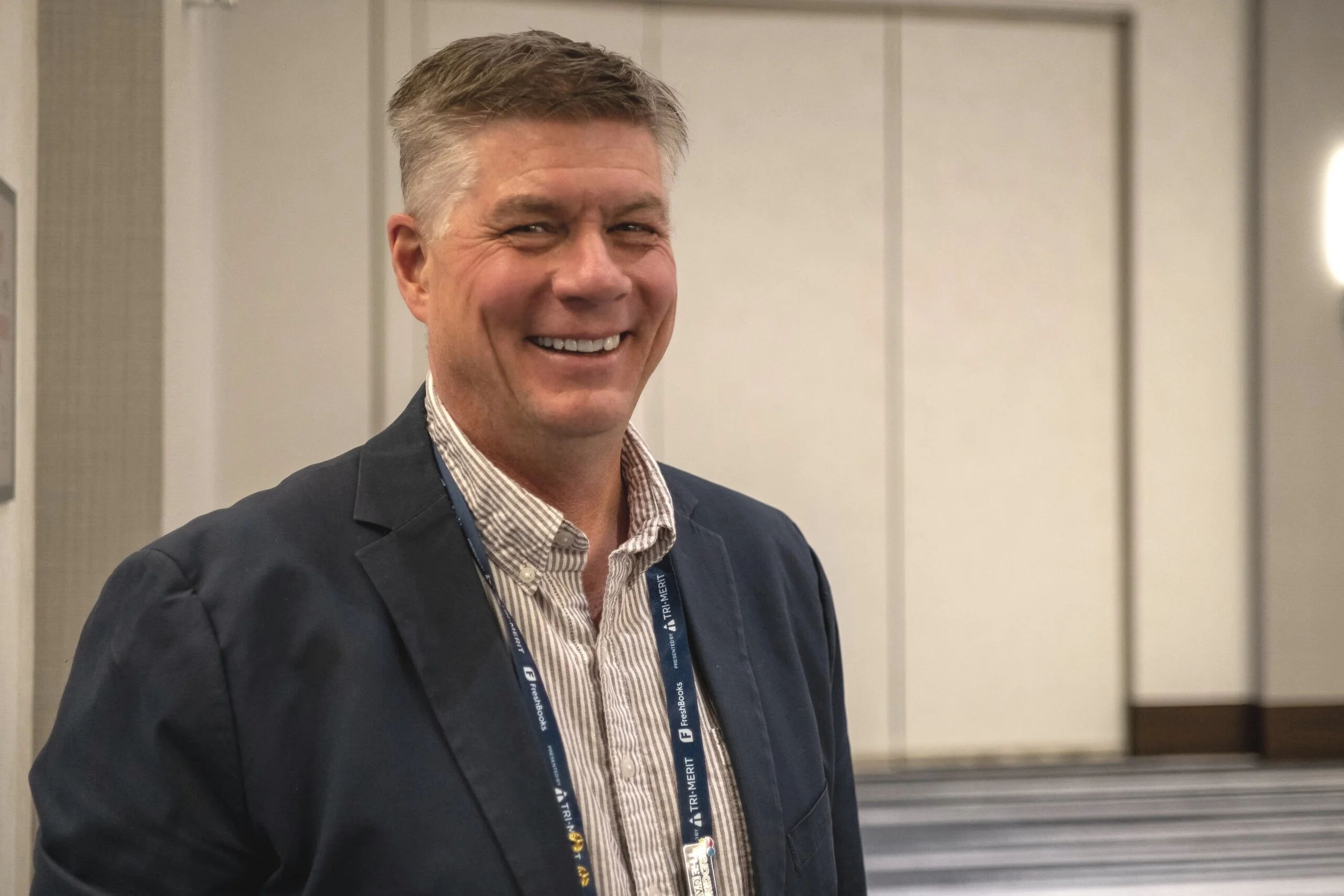
Randy Crabtree, co-founder and partner of Tri-Merit Specialty Tax Professionals, is a widely followed author, lecturer and podcast host for the accounting profession. Since 2019, he has hosted the The Unique CPA podcast, which ranks among the world’s 5% most popular programs (Source: Listen Notes). You can find articles from Randy in Accounting Today’s “Voices” column and the AICPA Tax Advisor, and he is a regular presenter at conferences and virtual training events hosted by CPAmerica, Prime Global, Leading Edge Alliance (LEA), Allinial Global and several state CPA societies. Randy also provides continuing professional education to Top 100 CPA firms across the country.

Terrell Turner is a 3x nationally ranked CPA, 2x Top 20 Global Finance Influencer. He is the founder of the TLTurner Group, which has been recognized in NYC Times Square and the NY Times as a top accounting and CFO firm that specializes in supporting law firms. Outside of running an accounting firm, Terrell hosts multiple vlogs and podcasts in addition to co-hosting The Unique CPA. Terrell is also a speaker and a content creator who regularly hosts and collaborates on video and audio content projects with multi-billion dollar corporations, bar associations, universities, and non-profit organizations.