
Giving Accountants Their Time Back
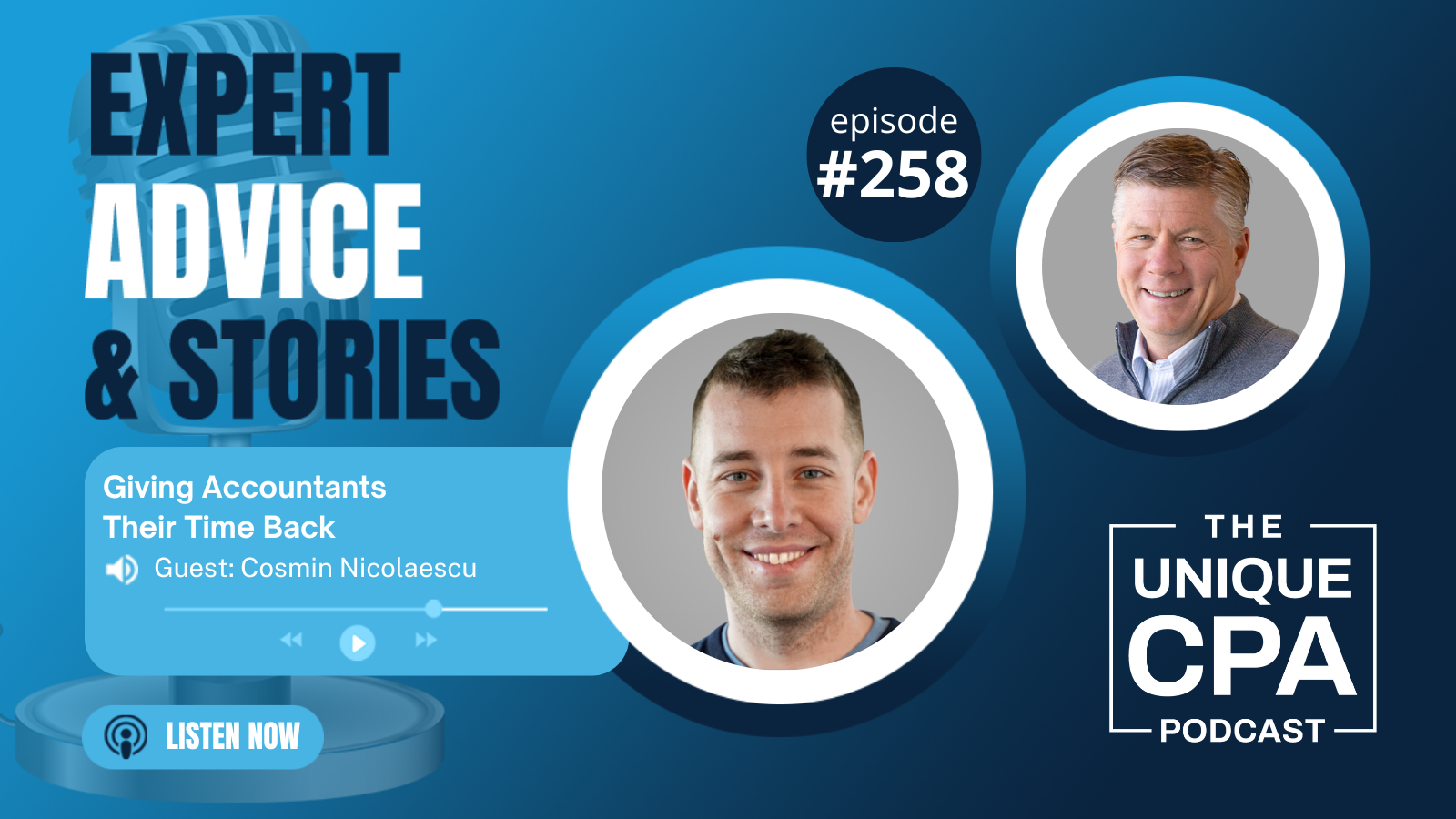
With Cosmin Nicolaescu
Support for this episode comes from BILL. Simplify your workflows and accelerate your growth with BILL’s accountant console. Take a demo today at BILL.com/uniquecpa for a $250 gift card – terms apply.
Cosmin Nicolaescu spent years at Stripe and Brex building the financial infrastructure that millions of businesses depend on. Now he’s turned that experience toward a different problem: Why are accounting firms still operating like it’s 1995? As CEO and co-founder of Accrual, Cosmin is building an AI platform designed to take the mechanical burden off CPAs and give them back time for the work that actually requires their judgment. Episode 258 marks part one of a two-part conversation on The Unique CPA where he talks with Randy about what drew him to the accounting profession specifically, how watching finance teams operate strategically at Stripe and Brex shaped his thinking, and what it looks like in practice when a firm cuts a 100-hour tax return down to 15.
Show Transcript Hide Transcript
Support for this episode comes from BILL. Simplify your workflows and accelerate your growth with BILL’s accountant console. Take a demo today at BILL.com/UniqueCPA for a $250 gift card – terms apply.
Today’s guest is Cosmin Nicolaescu. Cosmin is CEO and co-founder of Accrual, an AI-powered accounting platform. Accrual automates complex workflows, centralizes client data, and helps firms scale high quality tax and assurance work without adding operational burden. Previously, Cosmin was CTO at Brex, where he helped scale the company from 40 to over a thousand employees and hundreds of millions in annual revenue. Prior to his leadership at Brex, Cosmin was an early engineer and manager at Stripe, building a global payments infrastructure and launching Stripe Terminal. Cosmin, welcome to The Unique CPA.
Thanks so much for having me, Randy. That’s quite a history.
You’ve got the history! I just have to read it.
All the reading.
It’s pretty impressive what you’ve done in the past. And before we even get into that and before we even get into questions, and I didn’t warn you about this ahead of time, but I was thinking we should do a little story of how you and I met. I don’t know if you want to do it or I can try, but if I do it it’ll probably be wrong. So maybe you start with the story.
I’m happy to start. So for context for listeners, Accrual started about a year and a half ago, so towards the end of 2024. And as we started building the product, I started going to some accounting conferences. The first one that I attended was the Accounting Growth Forum in San Diego. Me and one of our team members came in, I believe it was like a Monday morning. I drove, I live in LA and so does he, so we drove down from LA to San Diego, got there a little bit early and then went to grab some breakfast. I sat down at a table, Randy was there with another partner from another accounting firm that I don’t recall the name of.
Me neither.
We just kind of said hi, and that was kind of it. Then later in the afternoon, or evening, there was a happy hour, and so everybody was kind of mingling around, and I noticed that a lot of people were saying hi to Randy, and so I was like, okay, I should probably get to know this guy a little bit more. I was also at the breakfast thing, and so there’s an easy intro. I hate networking events and I hate those times. It’s very draining for me, and I find it very awkward to kind of just jump in when other people are talking. And I spent a little bit of time with Randy, then got to go to his talk, which was the following day, very much about accounting culture and the office culture and how firm culture has evolved over the years and the current state. And I really quite enjoyed learning about those aspects, because I’ve been so focused on the functional aspects of accounting and accounting firms, obviously the technology side, and so that was really nice too, to kind of get more perspective on that. Fast forward a couple of months, me and my team go to AICPA in Vegas, obviously the largest accounting conference. I think it’s the largest accounting conference in the US.
Yes, yep!
And we go to, I think it was like the place where you have all the booths and stuff. And I see Randy, and not only do I see Randy, but I see like this huge line of people waiting to talk to Randy as if he’s the U.S. president. And I was like, okay, I’m not going to stand in line to say hi to him, but I will try to catch him afterwards. So I messaged Randy and I was like, hey, I saw you’re there, you looked really busy so I didn’t want to bother you. Do you want to meet up for coffee? The next day we met up briefly for coffee, and I told him about building Accrual. My co-founder and I worked together at Stripe, we’re both engineers, so we come from a very technology-oriented background. We have folks that we’ve worked with in tech, we have folks that we’ve worked with in kind of PE backgrounds, we have advisors from the industry because we’re trying to get the blend of folks with backgrounds in all the different kinds of companies and firms and industries that are most valuable to help the industry evolve as much as possible. And so I was like, hey, Randy, we’re just getting started, we’re trying to figure things out, we’re kind of building some tax automation, we’re kind of in the platform, and I told him a lot about the vision for Accrual, how we think accounting firms can actually transform over the coming years with the right technology and the right kind of first principles approach that we’ve taken. We also have folks in the industry who are advising us, very, very experienced. Would you be interested in getting involved in any kind of way? Honestly, I was expecting it to be like, didn’t I get these kinds of things every other day? Absolutely not. But thanks for the coffee. I don’t even remember if I bought you, no, I didn’t even buy a coffee because it was the coffee that the conference had.
I think so, yep.
But I do owe you two referral dinners, by the way.
I’m going to write that down right now!
I’m not forgetting that one. And you can either stack them as two separate dinners or one fancy dinner, whatever you want. For context, Randy has referred a couple of people from his network to Accrual that we hired and who are exceptional. We don’t do referral bonuses, but I’m very in favor of referral dinners. And yeah, basically Randy was like, hey, this seems really interesting, and it touches on a lot of things like how do we make accountants’ lives better? How do we help them focus their time and energy on the things that give them energy and that leverage their experience and judgment and backgrounds and so on and so forth, and not the mechanical work. So a really good mix there. And then we started spending more time together over Zoom and calls and got to meet more folks on the team, and it’s been really, really good. I think you’ve certainly made your mark already in less than a year on Accrual, both in terms of the help as we needed it, and also again, two folks that we have on the team are in big part thanks to you.
Yeah. Well, that was, I didn’t expect it to be about me, but I appreciate the context. The one thing that you forgot is you had sent me an email after the Firm Growth Forum event wanting to connect, and I never saw your email until you connected with me at Engage. I’m like, oh man, how did I miss this guy’s email?
Because you have a lot of emails!
Yeah, I do. But no, it’s been great. And I am officially a, what, strategic advisor? Is that my title with Accrual?
Yeah, we should figure out some fancy title for you. Strategic Advisor and Recruiting Chief. Chief Recruiting.
That’s true. I guess I am doing recruiting now too, but it’s been fun. Your team has been great. I’ve got to meet so many people on the team already. Every time I jump on a call with anybody, it’s amazing. You were in a session I did on culture, and I think the culture just from the people you brought in has been awesome. I’m excited about that and really excited about what you’re doing. We’re going to get into that now in a second here, but the things that you’re doing are going to help the profession so much, and there are things that we need to do in this profession, one with a lack of people coming in, but two, AI: You hear people say, hey, you’re going to be replaced by AI. That’s a bunch of, you know what. You’re going to be able to do what you love to do because of AI.
So let’s talk a little bit about what you’re doing at Accrual. But let’s start with, you know, you came from two accounting tools, Stripe and Brex, in the accounting profession. You saw an opportunity, you saw a need, for something else, AI being obviously a part of this. But what was the decision? Now is the time, I’ve got this great role at Brex, I’m CTO, but I see this vision, I see this opportunity, and what was it that you said this needs to be fixed, there is something we can do better? How did that decision come about, and then what was the game plan from there?
I would say both Stripe and Brex had obviously a lot of similarities to the accounting space in terms of a regulated environment, complex workflows, lots of moving pieces, things that have to stick together. Not the sexiest kind of work, if you talk to engineers, there are definitely, for many of them, more interesting things to do, but for Sid and me, these are the kinds of problems that generally excite us. And obviously there’s a huge amount of impact. Stripe completely changed the payments landscape, Brex revolutionized how corporate credit cards get underwritten and issued, and spend management, and so on and so forth.
And the other commonality that I would say Stripe and Brex have relative to accounting is how the accounting teams and the finance teams within those companies actually function. In particular, my mental model—and this is a sad reality, I think—is that in most companies accounting is a pure back office function, a very reactive function, one that tries to keep up with the business and mostly kind of papers things correctly once the business has made decisions, not being involved in the decisions and the strategic aspects of running the business. And again, I say that with sadness, not because I get any kind of joy from that. Stripe and Brex both, I think it was the opposite. At Stripe, when we hired Will Gaybrick as our first CFO, he kind of instilled that sense of product sense, strategy, and how we actually think about running the business with a very long-term view, and made sure we do our best job deploying our capital. At Brex, again, one of the first hires that we had was Michael Tannenbaum. He’s now CEO at Figure. He was the CFO at the time. He, again, instilled not just the discipline of running the functions, and I think that’s common at basically any good company, but what he did, and Will as well, was how do we actually ensure that these teams that are traditionally back office reactive teams are in the room to help make better business decisions?
The impact was quite substantial. Just observing that and seeing other companies, I was like, wow, there’s something really valuable about having those folks in the room and bringing a different perspective that isn’t shared there. And to the extent that they have that context, they can actually not prohibit the business and be naysayers, but actually help it make better decisions. So something for both Sid and I that kind of stuck around that, and when we were thinking about different industries, accounting was constantly towards the top of the list because we had seen that and because the shape of the problem is kind of similar. So we were like, hey, there’s definitely something there that we can do. Clearly the application of AI in professional services broadly is pretty obvious. I don’t think we’re rocket scientists or super innovators as if we’re the first to see that, but I certainly think it was one of the criteria that we looked at.
And then from there it was kind of like, okay, let’s understand the domain better. Because I think working with accounting teams in companies is just very different from working directly with accounting firms, and really going deep in understanding the domain. So we did a few things to do that: One, we did what I think every founder or aspiring founder should do, which is go talk to your prospective clients. We went and met a bunch of firm owners, CPAs at different firms of different sizes, individual business, audit, tax, CAS, you name it. We tried to understand what their current life is, what are the pain points, how do they think about the technology landscape. And it was very obvious, there’s a consistent pattern between one, technology is not very good in this space. It doesn’t feel like it’s kept up with other industries where there’s been so much innovation, where Web 2.0 and Web 3.0 have brought new and modern tools, and we’re still kind of stuck in a world from 30 years ago. Number two, very fragmented. Even if you have some tools that are potentially more modern, they solve a little, very niche pain point, and so it is very hard to get the efficiency gain across the workflows. And if you just observe what people are spending time on, if you think about the number of billable hours that CPAs have and how they spend most of the day, it is mostly on mechanical things rather than strategic, judgment-oriented things, which is what they’ve built decades of experience on.
Number three, you’ve mentioned it and I think it’s really broadly known, the shortage of CPAs in this country. So obviously when we look at that, it seemed like, how does the industry navigate that? Because that’s kind of a fact. And the only outlet seems to have been outsourcing. And so what I’ve seen is a trend in which I assume the Big Four will have outsourcing, but as you go down the list of firms, they just can’t afford the infrastructure to do that because it’s quite complex to set up. And I was surprised to see that now even firms that have like $10–20 million, some of them have outsourcing already, as a valve to get more capacity because they just don’t have any other way to keep up with their customers. I’m like, okay, so there’s a really good opportunity from a technical perspective in terms of the current landscape and what AI could do. There’s clearly a desire from the industry. It’s not a fear, it’s not a rejection of technology. There’s just a lack of technology for accountants to be able to use. Three, there are macro pressures in this market that if we do a good job, are favorable to us, are favorable to being able to give more capacity to accountants and not have to rely purely on outsourcing, or on outsourcing at all. We have some of our customers already that are basically moving work back to the United States completely as a result of using Accrual.
Wow.
Which is really exciting. And so as we look at some of those things, it just seemed like it checked off a lot of the boxes. And I think the final thing for us, which I hadn’t planned for as a criterion, but I think as we explored different areas it became very clear that it’s important, is how much do you enjoy spending time with your customers? You see founders all the time and I think founders tend to be in two buckets: They’re either mission-oriented, they think their purpose on earth is to solve X, cure cancer, go to Mars, you name it, and that is what they will do basically for the rest of their life. If you have that kind of clarity, congratulations, I’m super happy. For Sid and me it’s mostly about impact. I think the mission for Stripe and the mission for Brex were very positive, but it’s not like I was growing up and I was like, I want to be in FinTech and payments and all that stuff. That’s not my dream. I’m very proud of the work done there and I think, again, very positive mission. I look at what we’re building with Accrual in a similar way, which is I think there are a lot of not just direct effects that Accrual is having on the firms and then their clients, but there are secondary effects of how those influence the broader economy, and tertiary effects even, in terms of longer term impacts. So I’m very happy about that. But if you’re in the bucket of being more impact-oriented, you can get very enamored with, oh, I think this business could be really big, I think I can do this and that and the other. And I think that’s great, that’s necessary, but not sufficient.
The last thing for us to be sufficient, I think, is how much do I enjoy spending time with folks in that industry, with my clients? And as a founder, if you don’t enjoy that, you’ll certainly burn out. And there are certainly some ideas that we were exploring where the idea is really good, the market’s good, we can build something cool, we would enjoy it, blah blah blah. But do I enjoy spending time with folks in that profession as much? Not so much. Do I enjoy going to those conferences? Not so much. I think the thing that affects the most is, as a founder, you lose one thing—there are a lot of downsides to being a founder—but one of the biggest ones, or the most underrated ones in my opinion, is you are stuck in this company for much longer than any other employee. As an employee, if you don’t like it, you can leave, and again, there might be financial impact, but you’re free to go and find another job. As a founder, if the company’s doing really well it’s going to be very hard to leave because the company’s doing well, investors are not going to want the founders to leave. If the company’s not going well, well, no one really wants that job and it’s quite hard to move away.
So as a founder, you have to plan on spending a decade or more of your life in that business. And obviously you can pivot, you can do whatever, but that is the business. I have no idea what I’m going to want to do in 10 years. I think, again, unless you’re that sort of mission-oriented person who knows the rest of their life they want to solve problem X, it is very hard to know what you’re going to do. I couldn’t tell you 10 years ago what I’m doing today. I doubt I’ll be very good at predicting what I want in 10 years. However, I can give you signals on what are things that increase or decrease the probability that I’ll enjoy doing what I’m doing right now, and certainly spending time with my customer, which is a big part of my role, cannot be a draining aspect. I can’t be dreading meeting with accountants and accounting firms, I can’t be dreading going to conferences, I can’t be dreading speaking at conferences, I can’t be dreading understanding the domain of accounting. It was really good that both Sid and I actually really enjoyed doing that, both when we were at Stripe but also as we were doing the discovery process and meeting with firm owners and understanding their pain points and appreciating their craft for the work that they’re doing, and keeping a high bar and trying to build a good team in a very hard environment. There’s something really, really admirable about that. And so when I look at all those criteria, there’s honestly no downside reason not to do it, there are no negative reasons for not doing this, for us personally. And again, different founders have a different fit. That was the process.
That was quite a process. The key things I got out of that are that accountants are party animals and you like to hang out with them.
I did not say they’re party animals. You go to every conference in this world, so you would know best how party animals accountants are. I will not talk about your private parties at these conferences because I don’t think that’s appropriate.
That’s alright, they are! Accountants are fun. I enjoy it. Pretty much my customers are accountants as well. I love it. I’m energized going to hang out with the accounting industry. It just does something for me, just to see what they’re doing, just to see the innovation that they’re trying to integrate into their businesses. The things they’re not afraid of, for the most part. It’s weird because different size firms look at things differently. But there are many firms out there that are willing to take a risk or try something new. There are plenty out there that aren’t, but they’re going to have to, or otherwise they’re going to be passed by. But yeah, I never looked at it like that, why I chose accounting. I didn’t go through that whole process you did, but I’m glad I did, because I enjoy being in this profession.
Oh, I’m glad you did as well, for what it’s worth.
Well, thank you. I want to back up a second because you mentioned Sid a few times. We haven’t introduced who Sid is. Do you want to give us an introduction to your partner in crime in setting up Accrual?
Yes. Sid is Accrual’s other co-founder and he’s our CTO. Sid and I met at Stripe. He was one of the first engineers. He ended up being there for 11 or 12 years, I was there for about four and a half, so he was basically there for the majority of the company’s history. He was the most tenured person when he left, and basically he was leading, he was the technical lead for basically everything around payments, financial infrastructure, money movement, all the core pieces of Stripe. He and I worked together my entire time there. And he is not only objectively, both from my perspective and if you ask everybody else, the best engineer they’ve ever met, he’s also one of the most kind human beings you can possibly meet. And there’s something intoxicating about him and how he’s able to build relationships with anybody so quickly, and folks end up gravitating towards him and wanting to work with him and trusting him and vice versa. And so Sid is truly a one-of-a-kind, and I’m deeply fortunate to be able to do this with him. I don’t think I would be doing this without him, to be honest.
You just mentioned, and you didn’t use these words, “Silicon Valley Royalty.” But I heard that about both of you guys. Someone else said that as well.
Oh!
You guys have great reputations out with what you’re doing.
Thank you. You’ll never hear Sid or I say that, but I appreciate the kind words.
Yep, that’s no problem. Alright, so let’s go. We just set the stage. Everything that you’re doing, hey, you wanted to do something, you wanted to do something with Sid. You analyzed different industries. I love how you looked at, hey, do I like spending time with my customers? Now let’s talk about what Accrual’s doing because we haven’t even said that yet. We teased AI and we teased it’s accounting, but let’s get into what is it that you are actually building right now?
Of course. So we are basically building a platform that saves accountants endless amounts of hours and for a firm, basically generates the equivalent of additional accountants as a result of those savings. And especially our view is, again, how do we help accountants focus their time on the things that give them the most energy? I love writing code, I love the days I get to write code, and I’m fortunate to be in a position where I get to do that a large part of my job and my career. There are obviously things in any role that don’t give you as much energy, and that’s just the reality of life. When I talk to accountants, I don’t think most of them are spending time on the things that give them energy or on the things that they find uniquely valuable. If I talk to folks who just graduated or recent new grads, they’ll tell me they’re basically data entry analysts, paper pushers, and they basically have to go through, you can call it an apprenticeship model, you can call it hazing, you can call it whatever you want, but it’s basically something that clearly does not leverage their intellectual capacity and education. Everybody understands that you need to learn, and there’s a lot of experience that, look, I’ve taken all the CPA credits necessary. You certainly don’t come out of college feeling like, okay, great, I can now be a professional accountant and handle any complex situation. However, I think we can all agree also that you probably don’t need to do five to 10 years of data entry to get that experience.
And so if you talk to folks who are new, between the partnership model where you basically have to stay in a company for many, many years to have a progression, and the general leveling up, it’s pretty miserable. If you talk to senior people, they believe they’ve accumulated decades of experience, they know their customers really well, they don’t get to spend as much time with their customers because they have to have billable hours that are mostly done in the form of preparing, whether it’s a tax return, an audit, et cetera. They don’t find that particularly interesting. They just feel it’s necessary, which it is, and so they do what’s necessary, but they want to be spending time in different ways and they get most of their energy not from preparing one return or preparing an audit, but from spending time with those clients and understanding them and their needs better and figuring out how to help them, and again being much more forward-looking and strategic.
We believe with Accrual that today’s industry is disproportionately spending time on the mechanical and backward-looking work versus strategic, forward-looking work. And the goal for Accrual is to shift that balance and flip it on its head. So to give you some examples, we’re primarily focused on individual taxes currently, and now we’re building partnership returns and some audit workflows, so we’re looking at each kind of workflow and service line in an accounting firm and figuring out how to make the most of the capacity there. And for anything, if you think about it, for us we work with some of the larger firms and so very complex. Armanino, Creative Planning, for example, ultra high net worth individuals. In those cases, for them, a simple return will take at least 10 hours, probably more like 15 hours, and that’s a very simple return, probably for someone’s kid that they have to prepare returns for or their business. Those returns now get done in like two to three hours end to end, including the review, including everything. If you talk about more typical returns, those are 50 to a hundred or more hours. Those returns now get done in like five to 10 to 15 hours. And so order-of-magnitude savings and impact there that creates this capacity.
It’s not only the capacity that it creates for the accountants and how that will change the dynamics in the industry, but also the experience for their clients. And so we have a client portal and I’ve actually had literally several people, investors and founders, who have reached out to me because they’re customers of some of these firms, and that’s how they found out. They’re like, oh, we’re on Accrual, it’s so great. I’ve had investors being like, I know I’d never heard of Accrual because we just officially launched last month, but your product was really good when I went through my accountant, so I figured I’d reach out. The experience is much better from both a polish perspective, but also how we think about the questions they get asked for each client. So it’s not a typical 200 questions, but it’s very personalized based on what you’ve had in the past. It’s much more actionable, reminders are actionable, and so on and so forth. And so we see again, if I think about the main efficiency metric for end clients, it’s how much do you get to engage with your accountant as quickly as possible, and how little time do you get to spend on the mechanical work, because you generally want to spend little time on that. Normally, I would say when we first were getting started, client portal utilization in typical client portals in the accounting space are 20 to 30%. With Accrual, we’re seeing over 70%, about 75% utilization.
Let me back up on that for a second. So what do you mean typically 20%, now it’s 75%? Usage or data?
Yes, usage. So if you think about the number of clients that they have, let’s say you have a hundred clients that you prepare taxes for. 20 to 30% of them used to use your client portal. The rest of them would basically email you stuff, mail you stuff, didn’t send you stuff, etc. They just didn’t want to engage with another portal for a variety of reasons. And for us, now we’re seeing that out of a hundred, over 70% of those are now using the client portal.
And has it just become so much more user friendly? What is that increase due to?
I think it’s due to three things. Number one, it’s polished, it’s simple, it’s clean, it’s modern, so you have that. I don’t think that’s actually the most important thing. I think the delta between what we’ve built and what someone else could build is not insurmountable. But I do think we bring that polish and experience from Stripe. Our designer, for example, is one of the early Stripe designers. The second reason is you would normally get a list of questions from your accountant, and the way that accountant generated those questions was typically in the form of a template that they send to all their clients to fill out. The only scalable way you can do that is through a manual process, and it is not unreasonable. But the result of that, as a client, is I’m like, there are a ton of questions. Half of them I have no idea what they mean, they’re not applicable to me, this is just overwhelming and annoying, I’m just going to close this and eventually I’ll figure it out, or I’ll send some stuff to my accountant and then they can figure it out. That’s a very typical experience from what we’ve heard from both sides, the accountants and the clients.
What we do instead is we look at your last year’s return and we say, hey, we know that you had these documents, you had these interesting situations. We already have all that data from your accounting firm that you’ve been using, because most of this is like, over 90% of the business is continuing business, not new customers. And so for all those, we can generate a unique binder and a set of intake questions for you that are applicable. And so now out of 200 questions, maybe like 30 of them are applicable to me; now we will send you far fewer questions and the applicability is nearly 100%. Obviously you might not get a document this year that you had last year or a situation might change, but it’s very minor.
Moreover, we also have another philosophical difference here, which is we believe that documents answer a lot of questions that you would typically get in the form of intake questions. And so, for example, it is not uncommon on one of these intake questions to say, who’s your employer? Who were you employed by, and how much income did you have? Well, if I just give you a W-2, you can extract all that information. You do not need me to answer that question and then give you the W-2 that you obviously need anyway. And so we took the approach that we should bias significantly more on documents, and ask for all these documents, and ingest any kind of data, have the ability to get as much context as possible, whether it comes from an official document, manual documents, spreadsheets, emails, whatever it is, ingest as much as we can from that perspective and build the context around each client. And then for things that are not in documents, ask questions. And so now the common experience for an end client using Accrual for their taxes this season, is they’ll get a list asking for documents from last year, and they will get a very small number of questions like, hey, has this situation changed for you, for example? Have you made donations under $500, for example? There are some things where there aren’t necessarily documents, so you want to ask them questions. And then of course we allow the accounting firms to have other kinds of templated questions, but we work with them to ensure that they don’t overwhelm their customer, they’re not going to ask another 50 questions because we’ve given them enough confidence that, hey, you are going to get the information that you need, you don’t have to ask these questions, we will get these questions answered for you.
And the way we came about all this was, when we look and take a full step back, the intake process has two sides to it: there is the end client and the accountant. From the accounting perspective, they have a to-do list of, I need to have all this checked in order to prepare a return, and that is a very reasonable view. And what we’ve done in this industry for basically ever is take that and push it down to the end client. We said, “Hey, I have a list of questions, I’m going to give you a spreadsheet with 200 questions, you’ll answer those questions for me and to some extent help me do my job.” And then we took those questions and maybe put them in a portal to make it a little bit more modern, but in practice we had a single view of that list and we basically took it from the accountant and gave it to the end client. Our view is that the accountant should have their own view of the to-do list and a set of follow-up items and all that; that doesn’t need to get pushed to the end client. The end client doesn’t need to have that complexity. They’re not a CPA. They don’t need to see how the sausage is made. They’re not interested. The client should have a very small, actionable list of things, and then the accountant should have their own list, which is much more comprehensive, because that’s partly why they’re there. I think that’s probably the biggest reason why we think our utilization is much higher.
The third reason goes back to actionability. I think the most important thing when you interact with clients who don’t want to spend time on these things, because it is not exciting: I don’t want to spend time with my accountant on this, I want to spend time with my accountant on how do I optimize my taxes, is the level of noise. A simple example of noise, a common example that we used to get feedback from accountants who would want to see is, hey, what percentage of the binder is completed? We should send reminders to the customer. Because today accounting firms, many of them, have to send reminders to their clients because of course people don’t spend time on this, and so you get closer to April 15th and all of a sudden you’re kind of starting to freak out. I think that is a very reasonable ask, and so that makes sense. But the way you implement that is not to say, well, I have a list of 50 questions, you’ve answered 10, or I’ve given you 10 documents to upload and you’ve given me two, let me start nagging you constantly to upload those documents, because now it’s just more and more noise and you’re just going to start ignoring it. And so what we said is, okay, I think it is very reasonable to have reminders. Some people will do things earlier, some people will do things later, so that make sense, but those reminders should be actionable. If I send you a reminder as an end client saying, hey, you still need to fill out something, you’re never going to open that because you don’t even know what’s asked of you, it’s just generic, you’re going to probably delete it. The next thing is, well, I’m going to tell you the 10 things I need from you, and you’re going to look at that list. If that list is not actionable, you are going to dismiss it.
A perfect example is K-1s. Most of our clients have K-1s, probably over 90% of them, because we again work with more complex situations and so they end up having that. K-1s are just starting to roll out. I started getting K-1s in the last couple of weeks, so call it mid-March is when you start getting some K-1s; obviously W-2s, you start getting towards the end of January, beginning of February, 1099s start coming in towards the second half of February. If I send you a reminder in the beginning of February or middle of February, or even end of February, about K-1s because you haven’t uploaded K-1s, there’s nothing you can do about it. And all of a sudden now you’re going to tell me this is just noise, and even if you are asking for six K-1s and one 1099, for example, you’re going to ignore the 1099 because it’s probably lost in the sea of K-1s. And so again we were like, hey, the request and the need for accountants is very reasonable in order to nudge their clients to submit data, but how do we make it as actionable as possible? And so if you’ve given us the information that we think you should have by now, we shouldn’t send you any reminder, even if you still have work to do. I think it is reasonable to still have things to upload, but you don’t have those yet, and we know you don’t have those yet, and so we shouldn’t bug you until we think it’s actionable.
And so when you put all those together, I think that’s why you end up with a much higher utilization, because now it’s actually helpful for the end client: It is very helpful for the end client to say, hey, this interface is clean, it’s very easy to log in, it’s very easy to upload files, I don’t have to go file by file and line by line and, okay, for this line upload this file, for this line, I can just dump 20 files and the system will take care of it. That’s much cleaner. Obviously it takes so much less time. I know that when I’m prompted for something, I need to take some action, and so it’s pretty reasonable and it’s not overwhelming. So when we help them in a very specific, narrow way, their engagement is much higher, because they also want to get their taxes done and they want to help their accountant. It’s not that they’re malicious or want to make their accountant’s life harder, but they also had tools that were not necessarily helping them do that.
Thank you for joining us today for Part One of Randy’s conversation with Cosmin Nicolaescu, the co-founder of Accrual. Part Two will air April 14th. Head to RandyCrabtree.com for links, show notes and more, and be sure to hit that subscribe button so you don’t miss any great content. We’ll see you for next week’s episode on The Unique CPA!
About the Guest
Cosmin Nicolaescu is the CEO and co-founder of Accrual, an AI-powered accounting platform built to automate complex workflows and help firms scale high-quality tax and assurance work. Before founding Accrual, he was CTO at Brex, where he helped scale the company from 40 to over a thousand employees, and before that an early engineer and manager at Stripe, where he worked on global payments infrastructure and launched Stripe Terminal. Those experiences shaped his conviction that accounting teams are most valuable as strategic partners to the business rather than reactive back-office functions, the founding thesis behind Accrual, which he built alongside co-founder and CTO Siddarth Chandrasekaran. He is based in Los Angeles.
Meet the Host
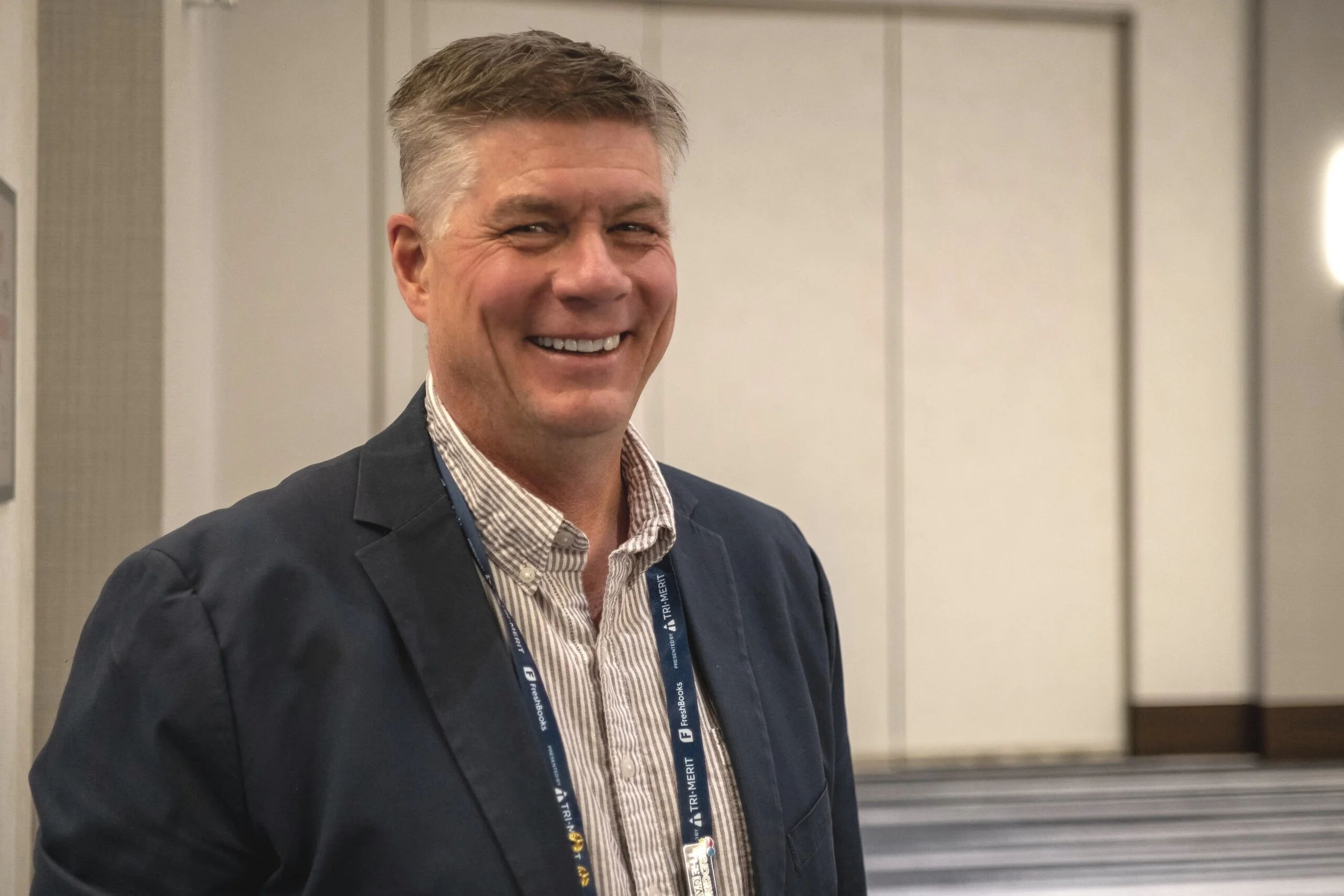
Randy Crabtree, co-founder and partner of Tri-Merit Specialty Tax Professionals, is a widely followed author, lecturer and podcast host for the accounting profession. Since 2019, he has hosted the The Unique CPA podcast, which ranks among the world’s 5% most popular programs (Source: Listen Notes). You can find articles from Randy in Accounting Today’s “Voices” column and the AICPA Tax Advisor, and he is a regular presenter at conferences and virtual training events hosted by CPAmerica, Prime Global, Leading Edge Alliance (LEA), Allinial Global and several state CPA societies. Randy also provides continuing professional education to Top 100 CPA firms across the country.